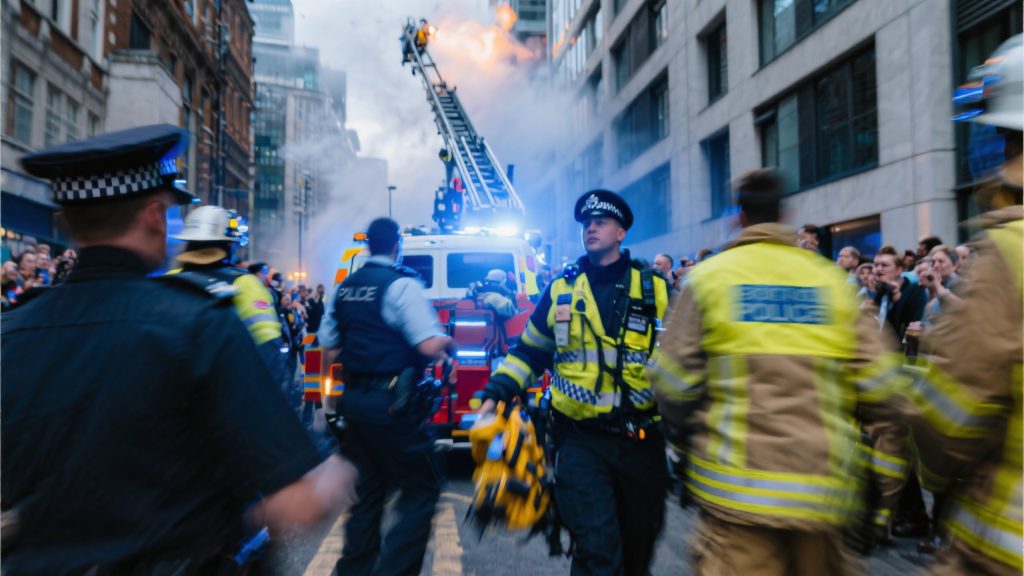
In environments where decisions carry life-or-death consequences, the difference between success and failure increasingly lies not just in immediate response capabilities, but in how effectively blue light services learn from every experience. Across UK emergency services, we’re witnessing a fundamental shift in how high-performing organisations approach organisational learning and continuous improvement.
The traditional model of organisational learning – characterised by paper-based reports, ad-hoc debriefings, and knowledge that disappears with staff turnover – is proving inadequate for today’s complex operational environments. When critical insights from an incident response in London fail to reach teams in Edinburgh, or when hard-won tactical knowledge developed by one force never reaches others facing similar challenges, emergency services aren’t just missing efficiency opportunities – they’re potentially compromising their fundamental mission effectiveness and public safety.
The learning revolution in emergency services
Progressive blue light services across the UK are recognising that systematic learning isn’t just about compliance or process improvement – it’s about building fundamental operational advantage. The most successful emergency services view every operation as a dual opportunity: delivering immediate results while simultaneously building collective intelligence.
When a fire and rescue service develops an innovative approach to high-rise incidents, that knowledge should be available to colleagues nationwide within hours, not months, when a police unit identifies a new crime pattern or tactical solution, the insight should immediately strengthen responses across all forces. For ambulance services, it means preserving and sharing clinical and operational wisdom that can mean the difference between life and death.
Beyond operational excellence: strategic advantage
While regulatory requirements and inspectorate expectations often drive initial interest in systematic learning approaches, forward-thinking emergency service leaders recognise the broader strategic implications. Blue light services that excel at operational learning and management don’t just perform better today – they adapt faster to tomorrow’s challenges.
Emergency operations generate vast amounts of tactical and strategic intelligence, yet much remains trapped in individual experiences or departmental silos. The blue light services that will excel in future challenges are those that can rapidly synthesise lessons from training exercises, operational deployments, and multi-agency cooperation into actionable intelligence that informs doctrine development and tactical innovation.
The cross-service learning opportunity
The most sophisticated blue light services are beginning to recognise that valuable insights often emerge from unexpected sources within the emergency services family. Police forces can learn from fire services’ approach to incident command and multi-agency coordination. Fire and rescue services can benefit from police expertise in threat assessment and public order management. Ambulance services can apply lessons from police and fire about rapid situation assessment and resource deployment under pressure.
This cross-pollination of knowledge within blue light services represents perhaps the greatest untapped opportunity in emergency service learning. When systematic approaches to knowledge capture and sharing become standard practice across all three services, the boundaries between forces become permeable, allowing best practices and lessons learned to flow freely between different operational contexts.

The implementation imperative
The transition to systematic organisational learning requires more than technological solutions – it demands fundamental cultural change. Leaders across all blue light services must champion environments where knowledge sharing is valued as highly as operational performance. This means creating incentive structures that reward teams for contributing insights, not just achieving immediate objectives.
Success requires breaking down traditional barriers between operational delivery and learning functions. The most effective emergency services integrate knowledge capture into operational workflows, making it as natural as completing an incident report or conducting a post-incident debrief.
Critically, implementation must be accompanied by analytical capabilities that transform raw operational data into actionable intelligence. Pattern recognition, predictive modelling, and cross-referencing capabilities enable blue light services to identify emerging threats and risks, optimise resource allocation, and anticipate training needs before they become critical.
As we evaluate the future landscape of UK emergency services, the organisations that will excel are those that recognise learning as a core operational capability. The question facing blue light leaders isn’t whether to embrace systematic learning, but how quickly they can build the capabilities that will define operational excellence in an increasingly complex emergency response environment.
For emergency services ready to transform their approach to operational/organisational learning and lessons management, practical solutions are already available. To explore how Northants FRS, Police and LRF embedded a systematic learning system tailored to their requirements and mapped to the UK Resilience Academy guidance visit isarr.com for detailed insights and case studies, or contact us at ess25@isarr.com to begin exploring your possibilities.
The industry will once again be gathering at the NEC, Birmingham for The Emergency Services Show, co-located with The Emergency Tech Show, on 17-18 September, check out the full exhibitor list here. You can find ISARR in Hall 5, Stand L193.