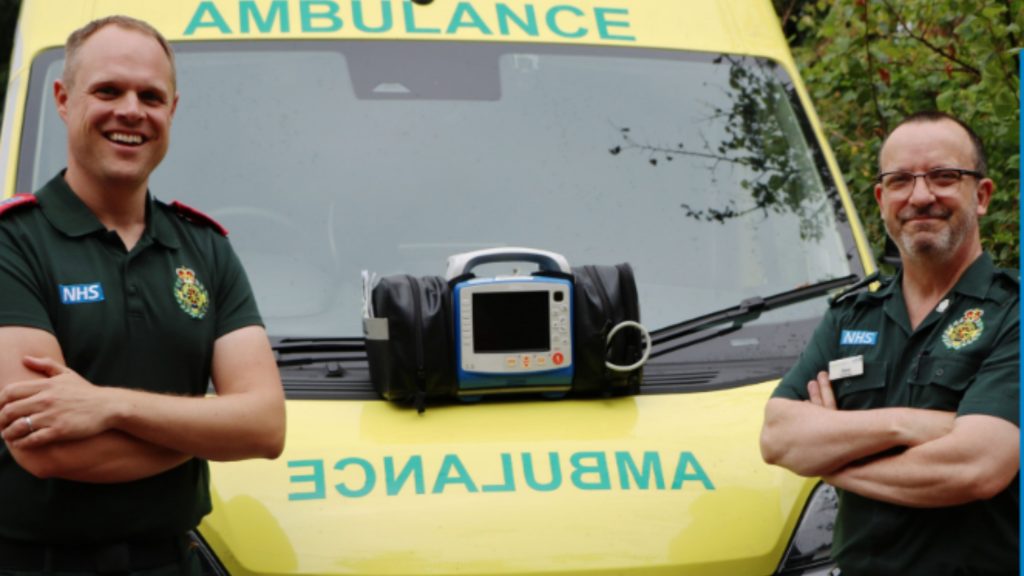
South Western Ambulance Service NHS Foundation Trust (SWAST) responds to 10,000 out-of-hospital sudden cardiac arrests (OHCAs) annually. Of those, slightly more than 3,000 present with treatable symptoms that benefit from advanced cardiopulmonary lifesaving skills (ACLS). Because SWAST serves a rural area, time to hospital can be 40 to 50 minutes.
Immediacy and quality of cardiopulmonary compressions (CPR) play an important role in the success of its response. With 4,000 staff members, most paramedics only attend two or three treatable cardiac arrests per year. Therefore, they rely on education and simulation training to build confidence and improve CPR skills.
In 2023, leadership at SWAST wanted to improve paramedic CPR skills and general knowledge of resuscitation science. Paramedic educator Steve Knowles was asked to oversee a new program using feedback from ZOLL Real CPR Help technology. A year after implementation, Steve and SWAST Education Lead, Guy Risdon share what they’ve learned, including how they:
- Rolled out CPR education that covers the breadth of cardiac arrest aetiology
- Built engagement and measured programme success
- Used real-time feedback from ZOLL Real CPR Help technology to increase paramedic confidence
- Used RescueNet CaseReview CPR event summaries to strengthen understanding of resuscitation science
- Improved followership and leadership skills
Embracing feedback
Guidelines organisations such as the International Liaison Committee on Resuscitation (ILCOR) recommend audiovisual feedback as part of a comprehensive quality improvement programme to help improve resuscitation care.
At SWAST, paramedics use the ZOLL X Series Advanced monitor/defibrillator, ZOLL CPR electrodes, and RescueNet CaseReview software to gather patient data. The X Series Advanced monitor features Real CPR Help, technology that displays CPR rate, depth, and recoil recorded by the accelerometer in ZOLL CPR electrodes. Tied to metrics for high-quality CPR, the CPR dashboard indicates how to improve CPR quality in real time, helping paramedics adjust their CPR delivery.
Data from each code event is pushed to RescueNet CaseReview and aggregated to identify systemwide strengths and areas for improvement. CPR Event Summaries detail the percentage of time CPR depth, rate, and release velocity meet high-quality metrics as defined by Guidelines organisations such as the American Heart Association (AHA) and the European Resuscitation Council (ERC).
Rolling out Resus Review
When this programme began, SWAST was already using data from RescueNet CaseReview to fine-tune training initiatives, complete required registry and NHS reporting, and address issues of patient harm. Prior to 2023, cases were not automatically pushed to RescueNet CaseReview. Instead, paramedics who attended an OHCA were gently encouraged to upload case data from X Series Advanced. On average, paramedics uploaded one event per week.
SWAST changed its guidance in 2023, asking paramedics to upload data following each OHCA. The team created a screen saver, stickers, and posters to share across the service to encourage adoption. Alongside central administrative support, an educator was assigned to each county within SWAST’s geographic area to:
- Monitor RescueNet CaseReview for cardiac event data uploads
- Respond to paramedics with CPR Performance Summaries and educational information
- Host bimonthly resuscitation workshops
- Engage with local management teams and paramedics
- Support Resus Review publicity efforts to encourage participation
- Survey paramedics about CPR confidence and general understanding of resuscitation science
The year in review
The change in upload policy gave the team more case data; now they receive two to three cases a week. Within 24 to 48 hours of each OHCA uploaded to RescueNet CaseReview, paramedics involved receive a CPR Event Summary that includes:
- Delivered CPR rate compared to high-quality target
- Delivered CPR depth compared to high-quality target
- Percentage of compressions in target for depth and rate
- Release velocity
- Compression fraction
- CPR pause times
Paramedics also receive ‘Understanding Your Data’, a document explaining the CPR Event Summary in greater detail and inviting them to reach out with questions or schedule an appointment with an educator to review it. They are also asked to complete a survey on the process.
Early on, it was challenging to get paramedics to come in for a consultation with an educator. “Now, people are interested to see how they’ve got on and how they can improve,” explained Steve.
The additional data has helped Steve and Guy identify patterns in CPR, highlight areas to focus on during engagement events and continuous professional development, and develop an annual training syllabus. They explore complex aetiologies that result in cardiac arrest and utilise feedback on X Series Advanced to demonstrate how best to respond in real time.
Learnings
With a year behind them, the team now has a broader perspective of CPR quality and areas to review during educational sessions. “People are full of adrenaline when they jump off the ambulance at an arrest, and we tend to start CPR really hard and fast, but then it settles down,” explained Guy. “The data that I’ve seen highlights some important areas that we can improve on during education days.”
For example, Resus Review data showed that paramedics found it challenging to interpret the perfusion performance indicator (PPI) on X Series Advanced.
By reviewing the science in conjunction with real-time feedback on X Series Advanced during training, educators demonstrate how gently releasing pressure from the thenar and hypothenar eminences improves perfusion between compressions and allows the CPR electrode to provide helpful feedback. Focusing on the recoil feedback helps compression depth fall in range more often. As a result, rates are closer to the recommended Guidelines.
“Using feedback has demonstrated the importance of chest recoil, which then allows improved cardiac perfusion,” noted Steve. “Now they’re seeing those perfusion windows fill up far better. That has been one of the biggest learnings. They trust that the puck (the ZOLL OneStep electrode CPR sensor) is giving accurate feedback.”
Bimonthly events were challenging for paramedics with dynamic schedules. Despite these scheduling challenges, the Resus Review team has seen positive results. Going forward, their education syllabi will be incorporated into the service’s continuous professional development days.
Training with feedback has encouraged coaching and strengthened scene management skills. Paramedics are open to critiquing each other’s practice and supporting each other during CPR. While one paramedic is delivering compressions, another is watching the feedback on the monitor, suggesting slight delivery adjustments. “I have seen eye-opening moments using Real CPR Help in the classroom when more experienced paramedics reappraise their view and embrace the opportunity to improve,” explained Guy.
Training with feedback has also improved on-scene teamwork. “The staff are very good at taking on the leadership role, taking a lighthouse (coaching) approach by standing at the feet end of the patient, lighthousing out tasks to promote bandwidth,” said Guy. “Now they coach each other and look at the quality of compressions rather than getting hyper-focused while sitting on an airway, trying to do everything all at once.”
Performance during simulation training has also improved. “Paramedics go into simulations with a much better pit stop-based approach, looking at followership as well as leadership, maximising their chest compression efficiency, and coaching each other,” noted Guy.
Progress and future challenges
The success of the Resus Review programme depends on paramedics’ response to support and subsequent educational opportunities. After each interaction with an educator, paramedics receive a survey to measure confidence in CPR skills, RescueNet CaseReview Event Summary understanding, crew resource management, and using RescueNet CaseReview feedback to improve compression quality.
To date, the Resus Review team has seen an increase in:
- Confidence in CPR skills
- Crew resource management
- Using RescueNet CaseReview feedback to improve compression quality
The programme plans to continue improving CPR quality and patient outcomes by:
- Using feedback as a way to lessen the emotional baggage of negative patient outcomes
- Standardising cardiac arrest protocols across different staffing streams
- Educating bronze tier commanders (leaders on standby to support crews responding to OHCA events) on SWAST-specific cardiac arrest protocols
To read similar articles, check out our Products channel.