


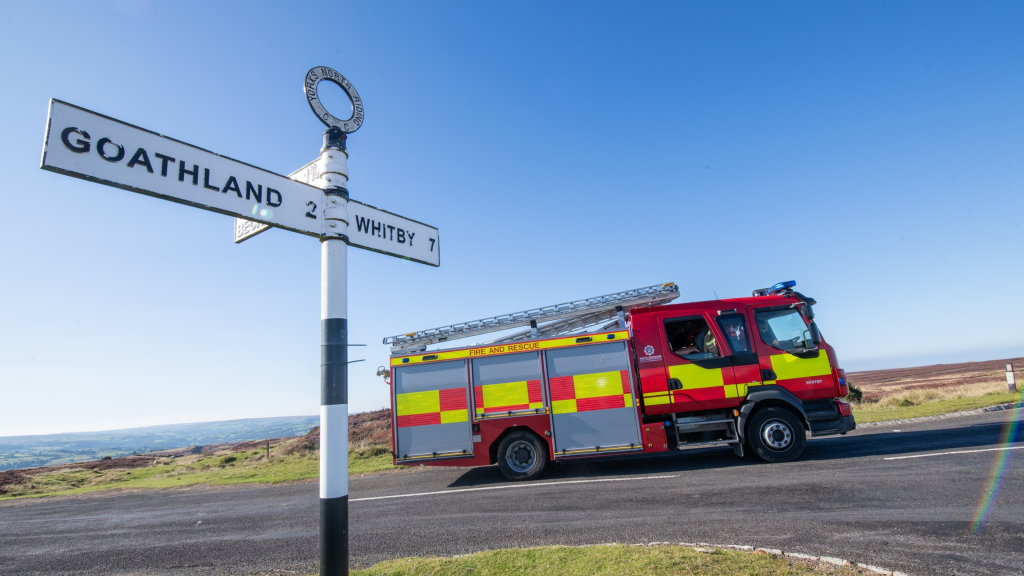
Against the backdrop of government’s emerging resilience agenda, here at the North Yorkshire Local Resilience Forum we have been exploring how we can strengthen emergency preparedness further by adopting new approaches to assessing our resilience through the use of scenarios and adopting national occupational standards.
The record-breaking temperatures experienced across much of the UK this summer have brought resilience firmly into the spotlight. Major wildfires have stretched emergency services, prolonged dry conditions have heightened concerns about water scarcity, and critical infrastructure has come under increasing pressure. These events have demonstrated that effective multi-agency and community preparedness has never been more important.
However, the challenges facing local communities extend far beyond severe weather alone. The risk landscape is becoming increasingly complex, interconnected and unpredictable, requiring resilience planning to address a broad range of threats and hazards. Alongside climate-related risks, local areas must be prepared for cyber incidents, infrastructure disruption, malicious activity, terrorism, public health emergencies, major supply chain failures and other emerging threats.
Recent years have shown that disruption can emerge rapidly, cascade across organisational and sector boundaries, and create significant impacts for communities, essential services and the economy. Increasing geopolitical tensions, hostile state activity and the growing potential for concurrent and compounding incidents further underline the need for adaptable and robust resilience arrangements.
While climate change is undoubtedly increasing the frequency and severity of some hazards, it is only one element of a much broader risk picture. Building resilience requires a coordinated, multi-agency approach that strengthens preparedness, response and recovery capabilities across all hazards, ensuring local areas are better equipped to anticipate, withstand and recover from future disruptions.
Whole of society approach
Recognising this changing landscape, the government has sought to strengthen the UK’s resilience through a more integrated, whole-of-society approach. This acknowledges that resilience cannot be delivered by any single organisation and instead depends on effective collaboration between a range of agencies such as the emergency services, local authorities, health providers, utility companies, voluntary organisations, defence partners, businesses and communities themselves.
This partnership approach lies at the heart of what Local Resilience Forums (LRFs) set out to achieve. LRFs are multi-agency partnerships that bring together emergency responders, public bodies, infrastructure providers and other key organisations to assess risks, plan, prepare and coordinate arrangements for emergencies affecting local communities. Through planning, exercising and learning together, LRFs help ensure that stakeholders can respond collectively when incidents occur and support effective recovery afterwards.
Like all LRFs, we maintain a Community Risk Register which identifies the most significant risks facing the area. However, we and our partners recognise that understanding risks at a strategic level is only one part of the challenge.
We wanted to understand how awareness translates, into operational readiness and whether organisations would be able to maintain essential services if those risks materialised. We also wanted a clearer picture of preparedness across the partnership – where organisations were confident, where approaches differed, and where common challenges or dependencies could affect our collective response.
Scenario Informed Resilience Assessment
To support this, the LRF recently undertook the Scenario Informed Resilience Assessment (SIRA). Combining an assessment of preparedness with an immersive, facilitated scenario, SIRA gave us an opportunity to examine our multi-agency response to prolonged and/or evolving disruptions.
This exercise brought together operational practitioners, emergency planners and business continuity leads from across the partnership. Independent facilitation brought two complementary perspectives to the process – workforce resilience and multi-agency emergency response.
Having that external perspective with experience from outside our own structures provided ‘fresh eyes’ on established arrangements, helping us to challenge assumptions and probe areas that may otherwise have gone unquestioned.
Rather than focusing solely on plans and procedures, the exercise challenged us to consider how we would operate in practice, asking vital questions such as:
- In the event of an emergency, how will critical information be accessed and shared securely?
- How will frontline services be resourced and prioritised?
- How effectively could partners coordinate if communication systems were disrupted or staff availability was significantly reduced?
- What arrangements are needed to support vulnerable people and the wider communities?
The discussions also reinforced the importance of considering resilience through a local lens. North Yorkshire covers a large geographic area with a mixture of urban centres, market towns, coastal communities and extensive rural areas. The resilience challenges facing these communities can vary considerably, so understanding how support may need to be adapted in different circumstances, and how partners can work together across boundaries, is essential to an effective response.
The findings were captured in a post-exercise report, bringing together strengths, gaps and areas of differing preparedness across the forum and translating these into clear recommendations for improvement. This gave us a shared evidence base for agreeing priorities and taking practical action to strengthen resilience.
National Occupational Standards
In addition to SIRA, North Yorkshire Council, the host organisation of the LRF Secretariat, is adopting the National Occupational Standards for Resilience and Emergencies. Developed by the UK Resilience Academy and The Workforce Development Trust, these standards provide an additional layer of resilience by helping organisations build the skills, knowledge and capability needed to respond to future challenges and emergencies.
Looking ahead, the risks facing our communities will continue to evolve, and the demands placed on emergency and public services will only continue to grow. The recent summer heat and wildfires are front of mind and hitting the headlines today, but the next major disruption could take a very different form.
That is why resilience cannot be viewed as a one-off exercise or a static plan stored on a shelf. It must be a continuous process of learning, improving testing and collaboration. By strengthening partnerships, understanding vulnerabilities and preparing together, we can ensure that when disruption does occur, our organisations, services and communities are better equipped to withstand it.
Ultimately, resilience is not defined by the absence of emergencies, but by our collective ability to anticipate, prepare for, respond to and recover from them. Local Resilience Forums provide the foundation for this collaboration, bringing together organisations with shared responsibilities for protecting communities and maintaining essential services. This partnership approach is central to how resilience is strengthened across North Yorkshire and will become increasingly important as communities face a more complex and interconnected range of risks in the years ahead.
To read similar articles, check out our Frontline channel.
