


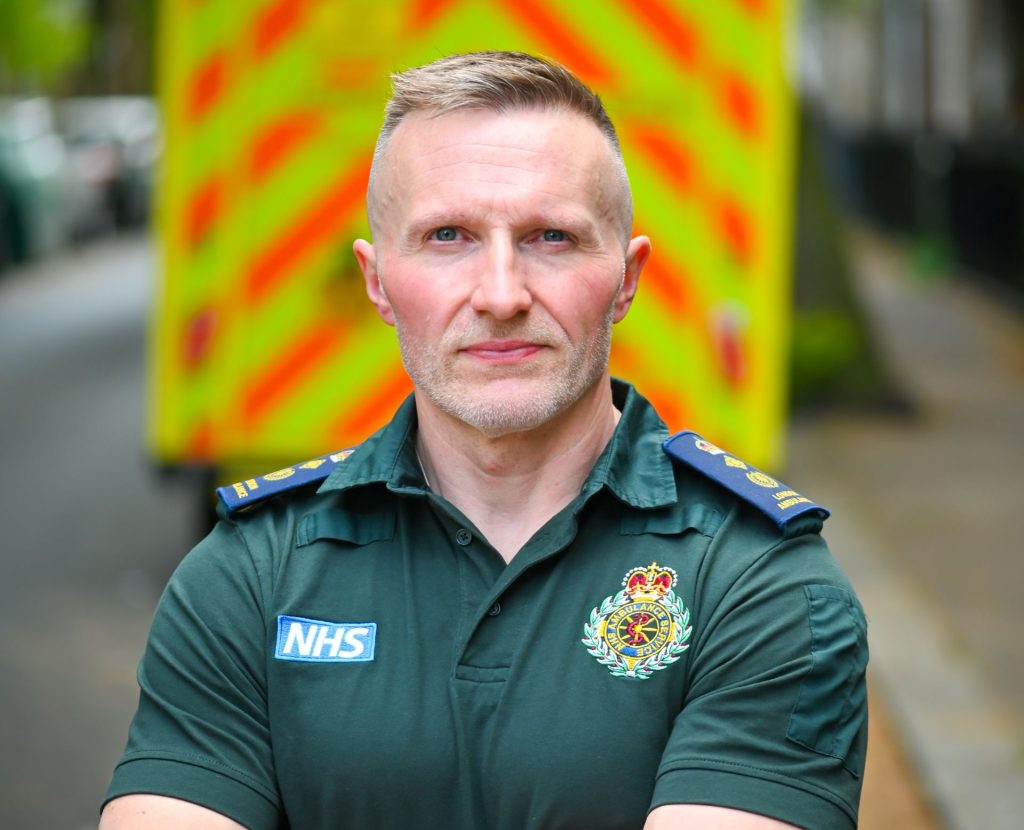
In the second part of this interview, the conversation continues with Jason Killens, Chief Executive of London Ambulance Service and Chair of AACE, turning to what needs to change and how the sector can move beyond incremental improvement.
If the current model is no longer sustainable, the next challenge is building one that reflects both the reality of demand and the capability of today’s workforce.
A workforce capable of doing more
One of the reasons this shift is now possible lies in the changing capability of the ambulance workforce.
Over the past two decades, the role of paramedics has evolved significantly. What was once primarily a transport-focused service is now staffed by highly trained clinicians, many of whom are working at advanced levels of practice across a range of settings.
“We’ve created a professional workforce that can do far more than it could 20 years ago. We’ve got advanced practitioners, prescribers, people working in specialist areas like mental health and end-of-life care. That development means the sector’s role can, and should, be different.”
Jason Killens, Chief Executive of London Ambulance Service and Chair of AACE.
At the same time, workforce dynamics are shifting. Lower attrition and increased training output have led to a surplus of newly qualified paramedics in some areas, creating both challenges and opportunities. Rather than limiting those staff to traditional roles, there is increasing potential to deploy them more flexibly across the system.
“We can generate a workforce of registered professionals who are trained to work autonomously in the community. The opportunity is to use that to support other parts of the system, while keeping people connected to the ambulance sector and developing their skills.”
From response to system leadership
Delivering that shift will require ambulance services to take on a broader role, not just as responders, but as active partners in shaping how care is delivered.
Historically, services have been defined by their response function. Increasingly, however, they are being recognised as having a unique system-wide perspective, with the ability to see demand patterns and variation in a way that other parts of the NHS cannot.
“The solutions to the challenges we’ve got aren’t going to be found inside a single organisation. We have to collaborate, because the answer for our communities is working together. That means thinking less about organisational boundaries and more about what patients actually need.”
That approach requires stronger relationships, shared responsibility and, in some cases, a willingness to give up control in pursuit of better system-wide outcomes.
From incremental change to transformation
While there is broad agreement that change is needed, the scale of that change remains a key challenge.
Incremental improvements have delivered progress in recent years, but they are unlikely to be enough on their own. Instead, what is required is a more fundamental rethinking of how ambulance services operate.
“The challenge isn’t about incremental change or fiddling around the edges. It’s about proper, brave, fundamental transformation in how we deliver care. That means rethinking our clinical model and how we work with others to create something that’s fit for today, and for the next 10 or 20 years.”
That transformation will need to reflect the reality of demand. Fewer than one in ten 999 calls are life-threatening emergencies, with the majority relating to urgent care needs. Designing services around that reality, rather than historical assumptions, will be critical to ensuring the sector remains sustainable.
Creating space to rethink the model
One of the biggest barriers to that kind of change is the day-to-day pressure faced by ambulance services. With demand constant and resources stretched, there is limited capacity to step back and think differently. Yet without that space, meaningful transformation becomes difficult.
“Day-to-day activity consumes most of our capacity. To genuinely change, you have to create space to stop and think about how you reimagine the service. Those opportunities are rare, but they’re essential if we want to improve care, improve the workplace experience and make better use of public money.”
The ambulance sector may be in a more stable position than in recent years, but the pressures it faces are not going away. What comes next will depend on how services build on the progress already made, accelerating towards a model that better meets the needs of patients, the workforce and the wider system.
You can read part 1 of this interview here.
To read similar articles, check out our Leadership channel.
