


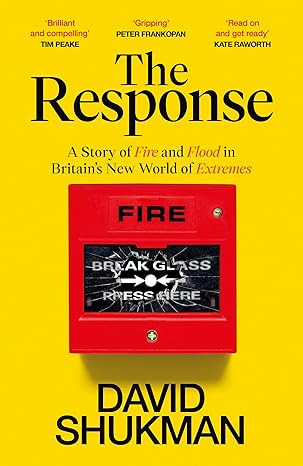
Former BBC journalist David Shukman has published a book that delves into climate resilience and looks at how the emergency services have responded in recent years. The Response sees David reflecting on 19 July 2022, the hottest day on record in the UK and looking at flooding that fills basements in modern cities with a fury that has the potential for huge loss of life. David spoke to me about what he learned about the climate threat by talking to those who it affects and considers how prepared society is to respond in the future.
When David joined the BBC in the early 1980s, climate change was not on the news agenda. His first major assignments took him into the heart of the troubles in Northern Ireland, working in small teams in difficult, sometimes dangerous conditions. It is where he learned how to read fast-moving crises and how to tell stories from the frontline. He moved soon into reporting on environment and science, travelling the world with the BBC.
Today, the frontline is climate change and yet he did not start out as a climate advocate. “Initially I was quite sceptical, sort of cynical, you know, could it really be that bad?” he says. That scepticism was gradually dismantled by what he witnessed in places like the Arctic and the Amazon, where he travelled to interview research teams and see for himself what was happening. “It was real, and it convinced me that this is a real problem,” he says.
From that point on, his reporting focused increasingly on how a rapidly changing planet would affect societies, infrastructure and, critically, the emergency services and public bodies expected to respond. It was natural then for him to gather this into a book, but rather than focusing solely on scientists, campaigners or politicians, he says he set out “to interview a lot of people whose voices you don’t normally hear from when you think about climate change.”
Extreme heat and wildfires
The book starts with the events of 19 July 2022, when the UK passed 40 degrees Celsius for the first time. David says that this was the day when a changing climate butted up against assumptions about what Britain’s landscape and emergency services can cope with.
Months of dry weather had turned grasslands, playing fields and parks into tinder and the result was a cascade of wildfires across England, including dozens in and around London. David examined London Fire Brigade records from that day and was struck by the level of strain. At one point, incident commanders at multiple locations were “screaming for more resources,” as he puts it, only to be told there were none to send. The brigade’s digital tracking tool recorded at 1415 that the “number of pumps available” in London was zero, something he says had not happened since the Second World War.
Houses burned in places such as Wennington and Dagenham on the north eastern borders of London, where residents had never imagined themselves at risk from wildfire. David recalls asking audiences of well-informed climate professionals how many homes were lost to wildfire that day around London. Almost no one knows, he says. The answer he gives them is 40 houses in the London area, plus others elsewhere in England, making it the largest loss of British housing to wildfire ever.
“The gap between the scale of what happened and public awareness of it is deeply worrying.”
Flooding and unexpected impacts
One of the most haunting stories in the book concerns Tony, an elderly man living in a basement flat in North London. David first came across the case in a few lines of an official report that mentioned an older resident nearly drowning during intense rainfall. He was also told by contacts in the London Fire Brigade that they worried about people in basement flats when there was very heavy rain and sewer overflows. Knowing that 11 people had drowned in basement flats in New York in similar circumstances convinced him this was no theoretical issue.
An investigation later showed that Tony’s building sat at the junction of two major sewers. During the storm, they filled beyond capacity, blew manhole covers and filled the street outside with a filthy mixture seeking any available low point. “Water will find its own level,” David muses. It poured down basement stairwells and into homes. A flat across from Tony’s filled to nearly three metres; luckily, it was unoccupied. Tony’s own flat flooded to about one and a half metres.
With his front door, front window and back doors all blocked, Tony thought he was going to die. David remembers how he demonstrated the position he had adopted, holding his forefinger and thumb under his chin, pushing his head upwards in a desperate effort to keep his mouth and nose above the water. The incoming flow slackened just enough that Tony could fight his way to a window, where a passing neighbour grabbed him and hauled him out.
“The story just left me outraged that in one of the richest cities on earth somebody might drown in their basement home just because it rains.”
These are just two stories in his book but they reflect themes that run throughout: systems and cascades. Extreme heat, in his account, does not just challenge firefighters on a fireground; it ripples through hospitals, transport, utilities and communities.
He cites the example of Guy’s and St Thomas’ Hospital in London on the 40-degree day, where air conditioning systems for key server rooms were not rated to operate in such temperatures. As condensers overheated, they failed to expel hot air, server rooms rose to 50 degrees, and IT systems collapsed. Within hours, staff found themselves reverting to paper, asking patients what medications they were on and why they were attending, because records were inaccessible.
“Very rapidly, what begins as an air conditioning problem suddenly becomes an IT problem, suddenly becomes a hospital staff problem, which then becomes a patient problem.”
Adaptation and learning
In The Response, David is keen to highlight examples of adaptation and practical change. For example after serious fires in Dagenham in 2022, Barking and Dagenham Council worked with London Fire Brigade to map and cut fire breaks: wide strips of closely mown grass at the edge of open land. He notes that the term “fire break” is well understood in Australia or Spain but was almost unknown in Britain until recently. When a subsequent grass fire erupted on playing fields in the area, those new fire breaks stopped its advance before it reached homes.
“That to me is a wonderful, low-cost, simple example of the kind of way we need to adapt to new conditions,” and as a result, he adds, behaviours shift. Accumulated across many places and services, he believes such adjustments can be transformative.
David’s career, from riots in Northern Ireland to melting Arctic ice and flooded London basements, has been about standing where systems are under stress and asking what happens next. With The Response, he is arguing that what happens next in the UK will depend on how quickly society accepts that the conditions the emergency services and others plan for have already changed.
David is chairing a back to back panel on the Protecting the Protectors stage at The Emergency Services Show. on 16 September. Exploring heat and wildfires first and then moving on to flooding, he and his panelists drawn from across the emergency services will discuss the issues in his book and what needs to change in the future. Visitors will be able to buy copies of The Response at the show and David will be doing a book signing after his panel sessions end at midday. Register to attend here.
