


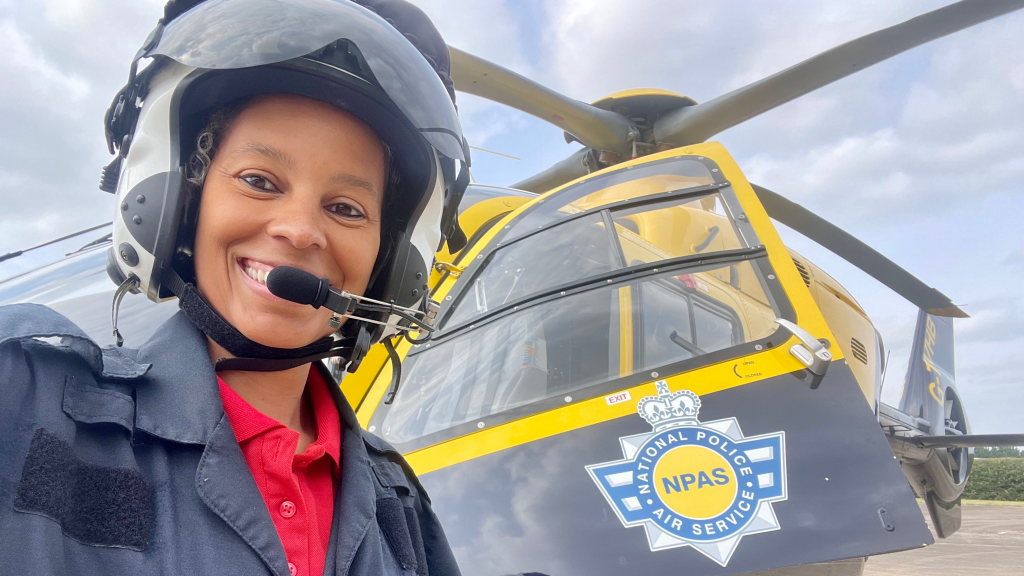
Understanding how partner organisations work when providing air response to emergency incidents is key to interoperability and that’s why I recently spent a 12-hour shift with the crew of the National Police Air Service (NPAS) at their base in Husbands Bosworth.
NPAS carries out a variety of tasks for police forces across England and Wales, such as searching for high risk missing persons as well as those who may be injured or where there is a serious concern for their safety and wellbeing. Common tasks also include searching for suspects, managing vehicle pursuits from the air and assisting with counter terrorism and specialist firearms operations.
Lowland Rescue assists police services in the search for vulnerable missing persons in urban, rural and lowland areas as well as providing support at major incidents, including fires, floods and rail disasters. Of the 34 Lowland Rescue Teams, 20 have a drone capability.
For both organisations, the time saved in locating people by deploying aircraft can mean the difference between life and death.
NPAS and Lowland Rescue sometimes share the same airspace when responding to incidents and I was keen to find out how they manage their searches from above and what differing perspective they have from us as drone operators.
Up in the air
Although this was my second visit to their base, it would be my first time joining the crew onboard the aircraft on live deployments.
The shift started with a flight briefing video, setting out the basic principles of flight safety and how to enter and exit the aircraft safely. I was then kitted out with a flight suit and helmet, followed by a weigh-in to calculate fuel requirements. The crew then showed me around the helicopter so I could practice getting in and out quickly in preparation for the shift starting.
Shortly after this, we received our first call out. Two motorbikes had been stolen and were being driven dangerously across a city, endangering the lives of the public. Flying at average speeds of 138mph, it didn’t take long to arrive on scene. Once air support arrives, it allows the following police to back off to prevent the risk of suspects feeling pressured into driving more dangerously. Frustratingly, after one hour and forty minutes, we had to abort the mission to head back to base to refuel.
The first thing that really stood out to me was the incredible teamwork of the crew who worked seamlessly together to track the suspects.
The pilot skilfully kept the helicopter located above the target, orientated so the rest of the crew could view the pursuit. Positioned beside the pilot, a second crew member controlled the sensor using a joystick and, next to me, a third crew member tracked the suspects using an onscreen map. The map displays where the sensor is pointing so they can communicate with teams on the ground to manage the pursuit.
Next up was a firearms incident and we were tasked with searching an industrial estate to locate the suspect’s van. This was a much quicker job, although very much as skilful, and we were back at base within 20 minutes.
After refuelling, we had a second operational brief which covered weather, airspace restrictions, crew health and flight safety. During every shift, the crew refresh their knowledge of a specific safety procedure which, on this occasion, was a tail rotor drive failure.
Shortly after this we were called back out to support a police dog team in locating the driver of yet another stolen vehicle which had a tracker fitted.
Laser pen attacks
Before starting our shift, I had asked the crew whether they still experienced laser pen attacks while airborne only to have it happen on our next deployment when responding to a serious sexual assault in a park. It’s hard to explain quite how bright the laser is in the cockpit but it’s a major distraction to the pilot and crew.
Little did the perpetrators realise, but it’s easy to trace where the laser is coming from using the long-range, high-powered sensor on the helicopter and we were quickly able to guide police in to make a house call. It was satisfying to watch a police officer visit the property of the offenders, then see their curtains draw and lights go out in an attempt to hide.
Laser attacks are a serious criminal offence, and the Laser Misuse (Vehicles) Act 2018 means that offenders can face an unlimited fine and jail sentence of up to 5 years for endangering an aircraft.
Back to base to refuel and refreshments, but our first sip of tea was interrupted when a call out came in to manage another vehicle pursuit. The car was quickly stopped by police who were able to deploy stingers following guidance from our crew.
Reflections on partnership
A return to base to our still-warm tea and some dinner before the shift came to an end.
It is sometimes assumed that organisations like ours compete with one another to launch air assets but that is not the case. With careful deconfliction planning, Lowland Rescue drone pilots can conduct focussed searches in support of foot teams while NPAS operate in the same area. By coordinating with the Police Search Advisor and NPAS control desk, both organisations can safely operate in the same vicinity with crewed aircraft favouring a higher altitude and wider search area.
You can read more articles by Emily here.
