


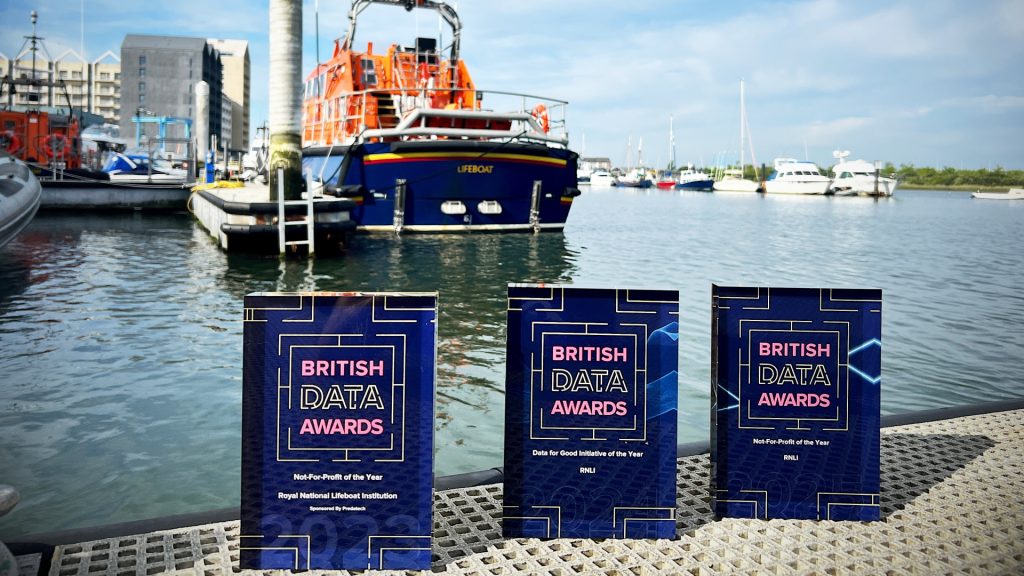
Winning the British Data Award for Not-For-Profit Data Team of the Year in 2025 marked a proud third consecutive win for the RNLI, following our 2024 recognition for Data for Good Initiative and our 2023 title as Not-For-Profit of the Year.
For any emergency service, to have our work recognised at a national event with over 450 entries for three years running is a welcome acknowledgement of our people’s long-term commitment and selfless efforts.
This success, however, is not a recent phenomenon. It stems from a core belief that has been woven into our lifesaving work for 200 years. Our philosophy of ‘curious innovation’ balanced with steady, practical progress isn’t new. It’s the same principle that evolved our all-weather fleet from oar-powered boats to steam-powered lifeboats, and eventually to the water jet-powered Shannon class lifeboats we build today.
It also saw us work with Atlantic College to pioneer the Rigid Inflatable Boat (RIB), a design that revolutionised inshore rescue. The way we summon our crews has evolved just as dramatically, from explosive maroons to smartphone apps. Across all this change, our goal of saving lives remains unchanged.
“The success of our data work is built on a foundation laid by our entire ‘one crew’ philosophy.”
Our frontline lifesavers provide the real-world experience and operational questions that spark new avenues of innovation. Our fundraisers generate the vital income that enables us to explore those questions, and our support teams provide the essential infrastructure that allows our specialists to focus on their work. Our data team’s role is to listen and to translate that collective effort into effective tools. It’s a virtuous cycle: frontline needs drive technical innovation, which in turn delivers frontline support.
This award recognised our careful approach to using AI, not as a replacement for human expertise, but as a powerful decision-support tool for our volunteers. This involves actively encouraging a ‘fail forward’ mindset, where learning is valued as much as immediate success.
In practice, this means using computer vision to help our lifeguards identify dangers or understand crowd patterns on the beach or using machine learning and neural networks to better predict lifeboat demand and understand factors that influence casualty survival probability. The goal is always to provide our teams with new insights, helping them anticipate challenges and direct resources where they will have the greatest impact.
Our commitment to using AI in a way that is ethical, affordable and sustainable was praised by the award judges. That comment gets to the heart of the challenge for every emergency service: how do we innovate effectively while maintaining the steadfast caution our communities expect?
The answer lies in two areas: building trust with your own people and finding like-minded partners. This means having the wisdom to know when to lead, when to follow and rely on their expertise. For a charity like ours, that collaboration is crucial, as it means the significant costs of research and development can be shared with partners who believe in our lifesaving mission.
As a volunteer crew member myself, I know the value of technology in supporting courageous people to perform extraordinary tasks.
“Our volunteers are the heart of the RNLI, but smart technology is the tool that enhances their skills, reduces uncertainty, and enables better outcomes in the most challenging conditions.”
Celebrating these awards is a powerful reminder to our entire ‘one crew’ that the work done behind the scenes with data and AI directly supports the lifesaving missions for which we are known.
This journey has taught us a simple truth. A successful data strategy in the emergency services is not about having the largest budgets or the newest technology. It’s about culture. It is about fostering a curious, questioning mindset, tempered with the operational wisdom to know that progress must be steady and sustainable. It is about building trust with your people by focusing on tools that help them do their job better and about finding like-minded partners to share the journey with.
This people-first approach has built a real and lasting momentum for us at the RNLI. For any service looking to do more with data, we believe a philosophy that truly empowers its people is not just effective, it is essential for lasting success.
In that spirit of shared learning, I attended the Emergency Tech Show advisory council and shared our approach with tech leaders from across the blue lights industry. We welcome other leaders from across the emergency services to connect to share insights on building a culture of innovation and embracing technology to support our teams.
The industry will once again be gathering at the NEC, Birmingham for The Emergency Services Show, co-located with The Emergency Tech Show, on 17-18 September, check out the full exhibitor list here. You can find the RNLI in the Collaboration Zone in Hall 5, Stand CZ51.
