


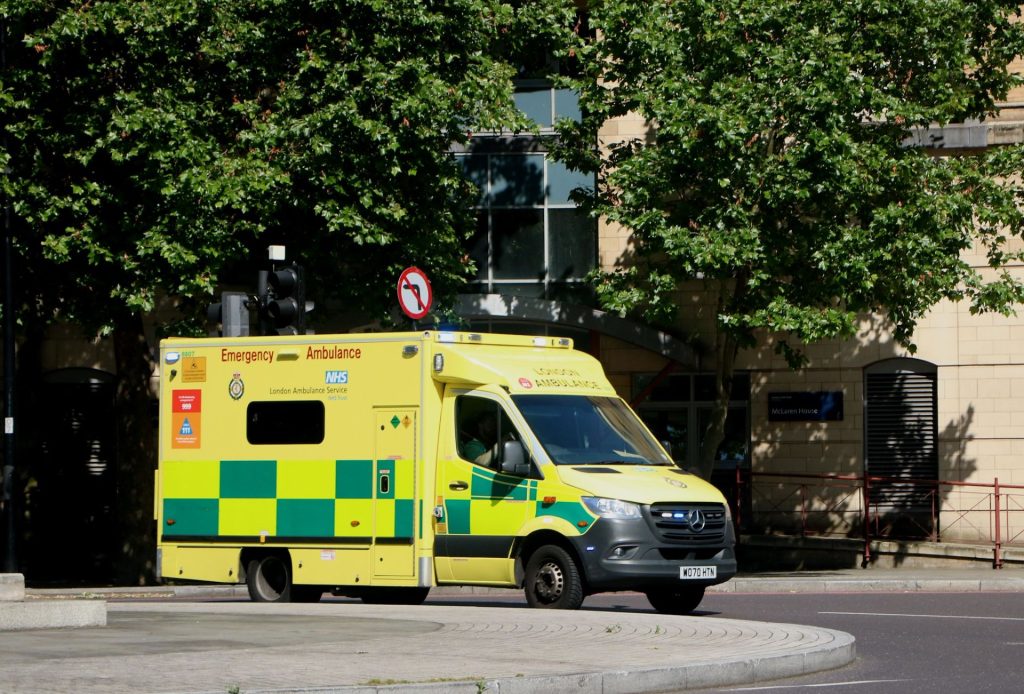
In the first of a two-part interview, Deputy Editor Lanna sits down with Jason Killens at the Ambulance Leadership Forum to revisit the challenges facing the ambulance sector, and why, despite progress in recent years, its core operating model may no longer be fit for purpose.
Ambulance services are still operating on a model designed decades ago, and without fundamental change, it will struggle to meet the demands of the future.
That is the view of Jason Killens, Chief Executive of London Ambulance Service and Chair of the Association of Ambulance Chief Executives (AACE), who says the sector must now move beyond incremental improvements and rethink how care is delivered across the urgent and emergency pathway.
In recent months, there have been clear signs of progress. Performance has improved, collaboration between services is strengthening, and there is a growing willingness to share learning across the sector. Those themes echo priorities Jason has previously highlighted, particularly around culture and closer working across services.
But focusing too heavily on those gains risks overlooking a more fundamental issue, one that sits beneath day-to-day pressures and performance metrics. At its core, the way ambulance services operate has changed far less than the environment around them.
At the same time, the primary remit of NHS ambulance services will always be to provide a rapid, safe and effective response to life‑threatening emergencies and major incidents, fulfilling their duties as Category 1 responders under the Civil Contingencies Act 2004.
As part of the nation’s critical infrastructure, ambulance services must maintain strong emergency preparedness and resilience. Any future transformation of the operating model must therefore enhance, not dilute, this essential capability, while also recognising that the majority of day‑to‑day activity relates to urgent care needs delivered across the out‑of‑hospital environment.
“What we’re doing now is largely the same as it’s been for the last 30 years. That model of responding, treating and transporting patients is still what underpins most of what we do. The challenge is that it’s not going to cut it for the next two to three decades.”
Jason Killens, Chief Executive of London Ambulance Service and Chair of AACE.
While conveyance to emergency departments has historically been a significant part of ambulance activity, the sector has already made substantial progress in safely increasing non‑conveyance and providing more care closer to home.
Yet demand has grown, patient need has become more complex, and the wider health system is under sustained strain. In that context, simply doing more of the same is no longer sustainable.
Handover delays are a symptom, not the problem
Few issues illustrate that strain more clearly than delayed handovers outside emergency departments. Ambulances queueing outside hospitals have become one of the most visible signs of pressure, but they are not, in themselves, the root cause.
Instead, they reflect a system struggling to manage flow across the entire urgent and emergency care pathway.
“Emergency department handover delays are a symptom of pressure across the whole system. It’s about capacity, flow through hospitals and what’s happening elsewhere in the pathway. But I don’t subscribe to the idea that this is something we just have to live with. Where there’s leadership focus and grip, you do see improvement.”
That distinction matters. If handover delays start to feel inevitable, there’s a risk they simply become accepted, even though the impact on patients and staff is significant. When ambulances are stuck outside hospitals, crews can’t get to the next call. The pressure doesn’t go away, it just shifts somewhere else.
“It’s not a dignified experience for patients, and it’s not what our people are trained to do. But the bigger issue is what’s happening in the community. When vehicles are stuck at hospital, you’ve got patients waiting hours, sometimes much longer, with nothing around them. That’s where the biggest risk is.”
A significant number of patients continue to arrive at ED, even though many could be safely managed through alternative pathways when available. Alongside flow through hospitals, there is a more fundamental question about how demand is managed before patients even reach emergency departments.
Ambulance services continue to convey patients to hospital when clinically appropriate, but the proportion is steadily reducing as more alternatives become available and evidence shows that with the right community options in place, even more patients could be supported safely outside hospital. When suitable alternatives are limited or unavailable, ED can become the necessary destination, which in turn contributes to wider system pressure.
“We know that somewhere between 40 and 60% of patients we take to emergency departments could be managed in a different way. If there were alternatives available that we could dispatch or refer into, many of those patients wouldn’t need to go to hospital at all.”
Shifting away from that model is not straightforward. It requires stronger integration with community services, clearer alternative pathways, and confidence among clinicians to make different decisions in often high-pressure situations. It also requires a willingness to rethink risk.
“What we’re doing today isn’t without risk either. Every service in the country will have patients waiting in the community that they can’t respond to immediately. So the challenge is how we manage that risk differently and more effectively across the whole system.”
The question for the system is how to ensure patients can access the right care in the right place, reducing avoidable ED attendances where safe alternatives exist. In part two, Jason Killens discusses how the ambulance workforce is evolving, and what a more flexible, system-led model could look like in practice.
To read similar articles, check out our Leadership channel.
