


The UK has just experienced a five-heatwave summer that saw temperatures reach 37 degrees, so it’s the perfect time to sit down with someone from the US who knows all about this and can offer insights into how we as a country can do better in terms of preparedness, response and recovery.
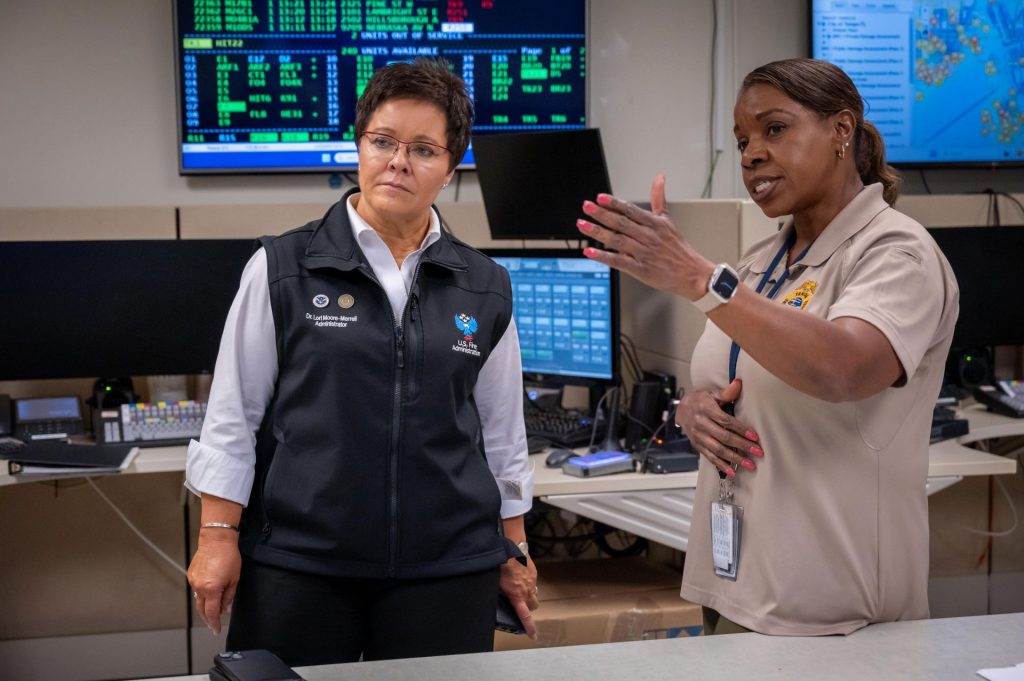
Dr Lori Moore Merrell is the former US Fire Administrator and she was in town to co-chair the World Fire Congress with NFCC chief Phil Garrigan. I grabbed a spot in her busy schedule to talk wildfires.
I wanted to know what Lori could share with us about the learning from the Palisades wildfires in and around Los Angeles last year that could help the UK. What had she observed that had changed in the US that we could learn from too?
She starts with a prosaic point: the UK needs to realise what is happening. “Don’t determine that it is a one-off event,” she cautions, referring back to the 2022 heatwave where the thermometer peaked at 40 degrees for the first time in the UK. We agree that the 2022 heatwave was seen as unusual and I suggested that we then forgot about it and moved on. “I would very much encourage you not to do that this time,” she says with a wry smile. “It is not a one and done.”
With El Nino garnering headlines of mythic proportions, next summer is set to be even hotter and the UK needs to prepare for what is to come as do our emergency services.
Lori wants us to think about where we have built and how vulnerable it is to wildfire so that we can be better prepared. “Did this land customarily burn?” she asks this important rhetorical question. In the UK we see wildfires in the vast rural space of Scotland or the moors of Lancashire but in the US, the geographical context multiples the risk many times over.
The interface between rural and urban environments has blurred – I recall the 2022 wildfires on the Essex/London border that ignited homes – and Lori says “we have built ourselves into the area of risk.” She talks the language of risk that emergency services people would understand but the wider public may not. “If people can understand where they live and the risk environment in which they live, they can better prepare for it.”
Returning to the learning from the LA fires, Lori says that anything they could have done better should have been done long before the first ignition. “The ignition was inevitable.” She describes ancient forms of land management that understood that fire is a natural process for regeneration and how that has faded into memory while at the same time building places where people live are being built “not with fire resistant materials, right in the path of fire, without any kind of fire break to protect them.”
Fire breaks and embers
We zoom in on the topic of fire breaks and how they are taken account of in the planning process for new homes where fire and rescue services are not always consulted before they are built. “They have to be consulted,” Lori asserts. “We call fire breaks ‘defensible spaces.’ They give us time but when we have wind, we have embers that are not going to be stopped by fire breaks. That’s a fundamental change in the risk environment.”
“That’s what happened in LA. This was a vegetative ignition. When it ignited it moved very quickly because the wind blew the embers from the trees that were burning and that’s what ignited the first home.”
With homes built close together, the radiant heatspread allowed the fires to jump from home to home, very quickly, driven by the wind, she explains. Alarmingly she says that at this point, the position is not to suppress the fire, “it’s pure survival. It’s getting people out.”
If the fire and rescue service’s role is not to suppress, then what is it? Lori tells me: “You’re not going to respond your way out of this. There is a shift in the risk environment, and in LA terms that meant a fire that outpaced 12,000 firefighters. She considers the Prime Minister’s response to the Stourbridge fires in August and has some sympathy for Andy Burnham’s offer of more money and equipment. “You will not respond your way out of this risk load,” she advises.
Lori is clear that fire and rescue services cannot approach wildfire response on their own, it is a partnership effort. But if wildfires are seen as a ‘fire’ problem, how can they talk with partners to get ahead of the curve?
Declaring this a fantastic question, Lori quickly gets into the detail, starting with the need for the fire service to understand the world they are operating in. She includes the political leadership in that too. She offers advice on how to talk to communities about knowing where they live – by that she means, the risks of the environment and making relevant, proportionate plans to respond to that risk. Looking at the vegetation in gardens and nearby land, she observes that some trees are more fire resistant than others, but who knows that?
She expands on this point by referring back to California. Recently passed into state law, Zone Zero refers to the proximity of combustible materials to someone’s home. “Nothing that is combustible can be within five feet of your house,” she explains, including decking, furniture etc., during wildfire season. This is meant to deal with the problem of ember spread that can quickly ignite a building.
Public messaging that works
I ask Lori how public sector organisations like fire and rescue services can inform the public without frightening them. “We need to educate the public, even if it is difficult to hear. If it is a scary message and they change their behaviour, well now they are safer.” Referring to conversations taking place at the Congress, she says there is a desire to take a very proactive approach to public education. “We’re not going to paper over this one.”
Turning at the end of our conversation to how the system can change based on learning from wildfires in the US, Lori talks about the US Wildland Fire Service which started work in January 2026. I ask her what difference will it make having a federal approach to streamline and modernise wildland fire management?
It’s an amalgmation of two federal organisations into one wildfire response and land management agency and Lori says that one benefit of this is the cross-training of staff so they have complementary skillsets and take a wider view on wildfire preparation and response.
While it is a re-ordering of public organisations around the wildfire risk, it is aimed at federal-owned land and in the US land can be owned by the state and smaller local areas. The Palisades fire showed firefighters from all three jurisdictions working together because of the sheer size of the wildfire spread. “Fire doesn’t recognise borders,” says Lori, noting that truism works for the UK too.
Dr Lori Moore-Merrell is the former U.S. Fire Administrator and Chief Fire Safety Strategist at UL Research Institutes’ Fire Safety Research Institute and was speaking at the World Fire Congress held in London in September 2026.
