


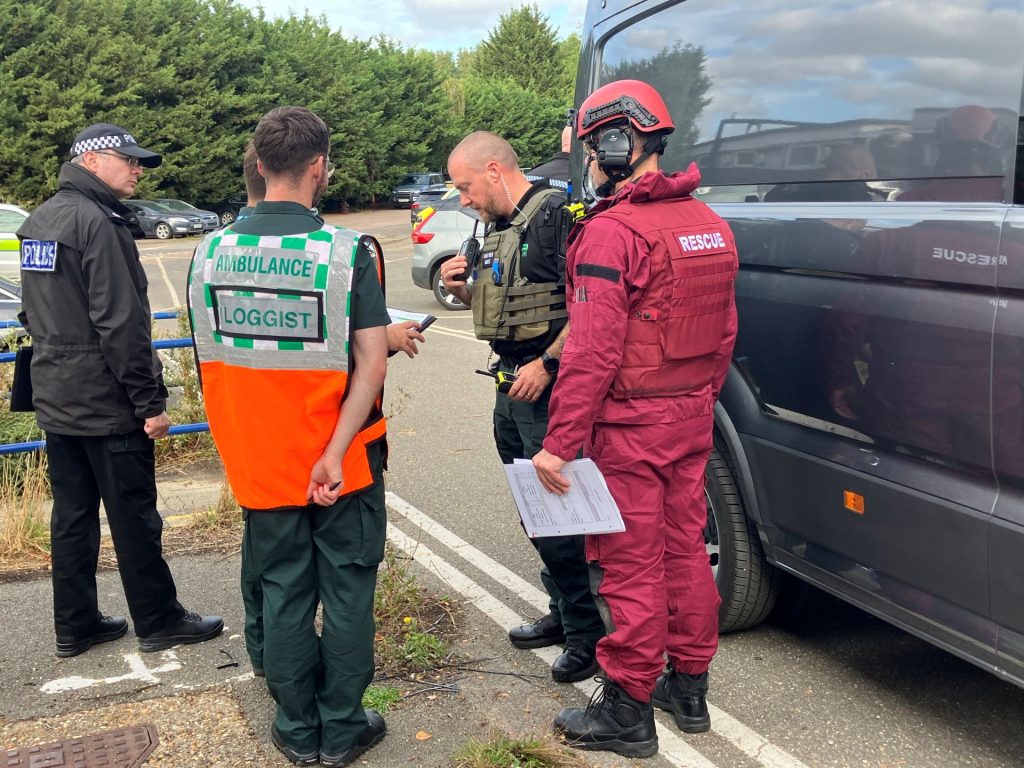
In the east of England, exercising is taking on a regional flavour as the ambulance service runs Exercise Apollo in an abandoned hospital site testing out terrorist scenarios that see thousands of staff from across police, fire and ambulance participate over 20 separate days. It’s a huge effort under the expert direction of Steven Moore, I went along on a warm day earlier this month to find out how it all works and what’s in the packed lunch that fuels the troops.
I’m not the only observer on this day and join a group who mostly come from healthcare settings across Essex to watch the scenario unfold; we are all looking to increase our understanding about multi-agency response. The exercise begins with what looks like just a household fire alarm going off and a scuffle in the street, but as the scenario unfolds, it’s clear there is more to it.
Our guide from the East of England Ambulance Service NHS Trust (EEAST) says that the first responders arriving on scene are doing a ‘windscreen survey’ to determine what they can see outside the row of houses. Soon after, we learn there is a bomb factory inside a house nearby and the risks at this incident change rapidly.
Those first responders send a METHANE report to provide more information back to control. This is the first stage of JESIP in action and our guide tells us about the side-ways views that responders take to be aware of what’s going on and get ideally a 360 view on the incident. “Don’t put your whole focus on the patient, you need to look at the whole scene,” he advises paramedics, drawing on experience from other terrorist incidents.
It’s interesting how our guide draws the past to illustrate the approaches being taken today by the participants in this exercise. We hear about the adoption of Ten Second Triage which came out of the learning from the 2017 Manchester Arena bombing.
“We work on the most for the most. We’ll try to get round as many casualties as we can in the fastest time, working out whether they are P1 (priority one) needing the most care to P3 (priority three) who are the least impacted.”
This is the reality of the very early stages of the scenario that we witness at this former hospital site.
One example of recent learning that could end up being adopted at a national level is the use of a simple record card on a band wrapped around a casualty’s wrist to show what drugs have been administered at the scene. “We recognised that we had nothing to write on to say what life saving medication the casualty had received. We know that one clinician doesn’t stay with a casualty throughout so when it came to handing them over, there was nothing to pass on.” It’s a simple change but he says it makes all the difference to casualty care at all stages.
Midway through the day, I talk to Steven Moore, he’s the Head of Emergency Preparedness and Specialist Operations for EEAST. He tells me that they’ve already captured some useful learning about the use of language used by different services when sharing information.
He says this example is why JESIP advocates simple plain language, as at an incident, one word can mean different things to different responders. The word in question at Exercise Apollo was associated with evacuation and because it simply wasn’t the word ‘evacuate,’ not everyone understood its meaning, he explains. This learning will not only be shared as part of the debrief report, but also with the national JESIP team.
We talk about equipment and I ask about Sked stretchers – a flexible hard plastic stretcher that can secure a casualty and allow them to be pulled to safety by two responders. “We’ve had some really good experience of using Skeds here. We are moving casualties effectively on them today, but it’s not just at this type of incident we use them,” he explains, going on to talk about their use at the Bedford train crash that took place in June. He describes how well they worked to move casualties across a ploughed field where it was challenging terrain to carry people or use a wheeled stretcher. “Using a Sked was much easier. and they are quick to get someone out of danger.”
While waiting for the final part of the scenario to unfold, where armed assailants will soon fire their guns in a bid to escape from the armed police outside another hospital building, I talk to Temporary Deputy Chief Constable Stuart Hooper from Essex Police. He has been there all day as the Gold commander and strategic firearms commander, observing the scenario that includes Essex Police officers along with those from Norfolk and Hertfordshire.
This is part of the firearm team’s training calendar; they have to maintain a level of training to be qualified to hold a weapon.
“They are not abstracted from the frontline, this is built into their training programme so that we can re-licence them to be armed officers. An incident like this doesn’t happen every day. We need to prepare our staff for when an event like this does.”
It is fascinating to talk about firearms with a police chief, it is not something I have seen up close but observing the scenario play out we don ear plugs and safety glasses lest stray shrapnel come our way and watch the officers in action. It is loud and fast paced.
He reminds me that building relationships at training exercises like this one is really important so that when they meet at incidents in the future, they are asking ‘how are you?’ and not ‘who are you?’ So it is good to talk to Area Manager Dave Bond from Essex County Fire and Rescue Service, he is at Exercise Apollo as one of the NILOs.
The National Inter-Agency Liaison Officer role emerged out of the learning from 9/11 and the national team marked 25 years last month. Dave is there to complete his CPD training. “The role of the NILO is crucial,” he explains. “We are able to pull all three agencies together, co-locate and communicate under the JESIP principles.” It is good to test yourself in extreme environments, he tells me.
In a perfect circularity and end to my day of observation, Dave says that for fire and rescue, it’s likely that a terrorist incident won’t come into their control room defined as such, it will come in as road traffic incident or a fire. And it did in this version of Exercise Apollo: what the fire service thought was one thing, did indeed turn out to be something completely different.
Steven Moore will be joined by Wayne Gibbons from Hertfordshire Fire and Rescue Service and James Southwell from Essex Police for an exclusive webinar chat about Exercise Apollo. Register to join them on 5 November at 1400 using this link https://www.crowdcast.io/c/exercise-apollo-multi-agency or below.
