


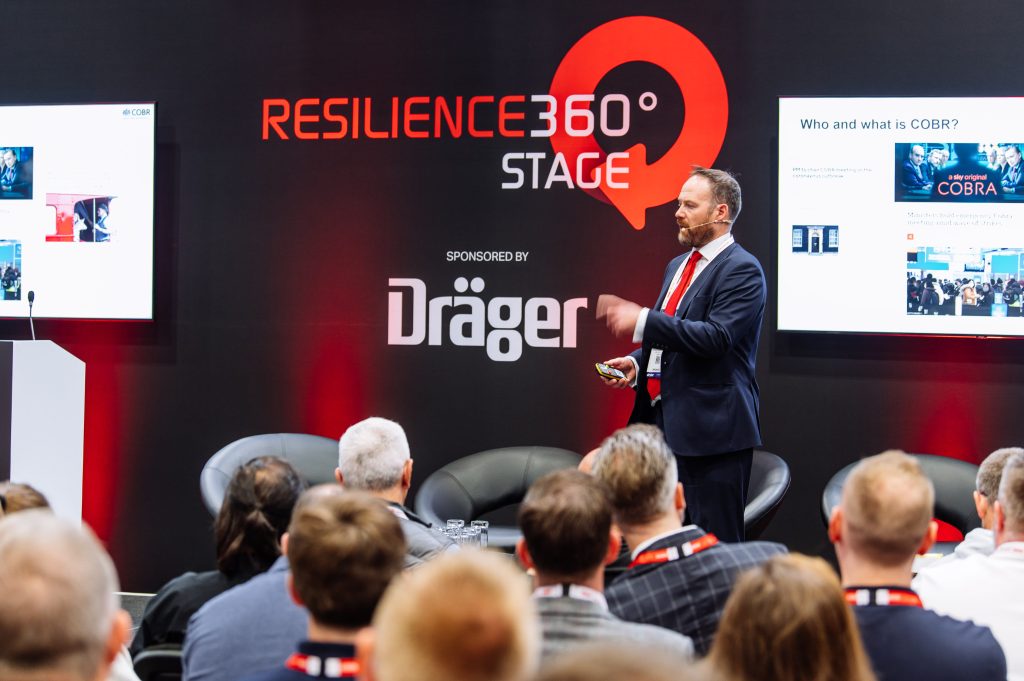
Senior civil servant, Roger Hargreaves, who is the Cabinet Office’s COBR director, says the UK must broaden its approach to emergencies because government cannot build resilience alone. He told an audience gathered at this year’s Emergency Services Show that the country’s response depends on public services, businesses, local organisations and communities being prepared and working together.
“My story is never complete unless it’s a story that involves everybody,” Roger shared with delegates as he gave the keynote address on the Resilience 360 stage. This is now available to listen to as the opening episode of the latest series of For Every Response, the podcast from Emergency Services Times.
COBR’s work spans risk assessment and prevention as well as coordinating responses when a crisis occurs. Roger described a risk landscape under growing pressure from international instability, climate extremes, biological threats and community tensions. Artificial intelligence may also make some malicious activity easier to carry out. Traditional risks, he stressed, have not gone away.
The UK’s approach remains all-hazards and preparing for conflict remains important but it should not displace work on pandemics, severe weather or other emergencies. Roger said the aim is also to move towards a whole of society approach, in which people are not only recipients of help but can contribute to resilience. “There has to be a recognition that support for the work the state does in crisis has to flow in both that direction back to the state as well as from the state out to the citizen,” he said.
That shift matters, Roger argued, because recent crises have led people to expect the state to step in. Government support remains essential, but public preparedness and participation can strengthen the response. Lessons from COVID-19 and the response to the Grenfell Tower fire have also reinforced the need to prioritise vulnerable people in emergencies.
For individuals, preparedness begins with practical steps. Roger said the planned public information campaign would cover household readiness: keeping three days’ worth of food and water, having a torch and essential medication available, knowing emergency contact numbers, and understanding whether someone is on a utility company’s priority services register. The campaign, expected to land this Autumn, will be the first proactive government effort of its kind since 2005.
But resilience is about more than household supplies. Roger pointed to existing ways people can contribute, including volunteering as a retained firefighter, special constable, NHS volunteer or coastguard volunteer. Communities can also support one another and practise how they would respond. The government is examining why some communities appear to cope better than others during emergencies, including the contrasting experiences of communities affected by Storm Goretti in Cornwall at the start of this year.
Roger acknowledged that local capacity and voluntary-sector involvement are uneven. Some local resilience forums work closely with voluntary organisations; others do so less effectively. The challenge is to make better use of both established organisations and community-based groups, while recognising that local needs and capabilities differ. “Everyone has a role to play here and everyone can do something which makes an impact,” he added.
That requires more dialogue between central government and the people and organisations involved in local response. Roger said his team plans regional workshops on home defence and state threats, followed by discussions on pandemic preparedness. It also aims for every local resilience forum to hear annually from someone with authority from his unit, creating opportunities to explain plans and hear local priorities.
The public campaign and workshops are part of a wider effort to bring resilience out of government documents and into everyday life. Roger said the government must be ready to explain risks honestly, invite challenge and make it easier for people to understand how they can help. The aim is not to transfer responsibility for emergencies away from the state, but to build a stronger partnership between government and society.
Concluding his keynote, Roger urged the audience gathered at The Emergency Services Show to help shape that work. “We need to do it together,” he said. For households, communities and organisations alike, that means understanding the risks, preparing where possible and finding practical ways to support one another when a crisis comes.
Listen to the keynote in full on your favourite podcast platform or use the link below. This is the first in a series of highlights from The Emergency Services Show and The Emergency Tech Show 2026.
