




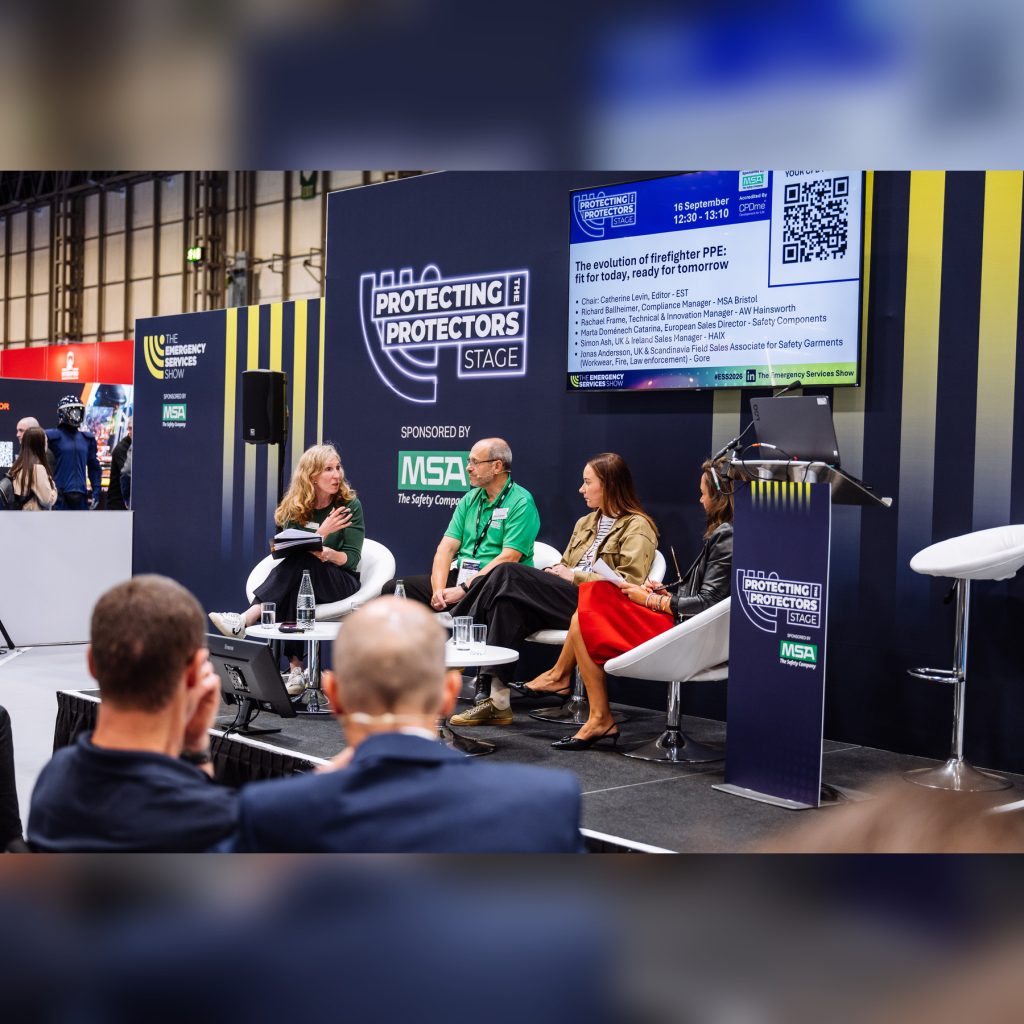
Firefighter protective equipment has to do more than withstand heat, it must fit the wearer, suit the task, work as part of a complete ensemble and keep protecting through repeated use. At this year’s Emergency Services Show, MSA Safety sponsored the Protecting the Protectors stage and led the conversation over the two days about how to achieve protection in more ways than one.
Meeting the demands of the frontline means working closely with suppliers and firefighters to develop kit from top to toe. To discuss this, Catherine Levin hosted a panel on the first day of the show with Richard Ballheimer, compliance manager at MSA Bristol, alongside Rachael Frame of fabric manufacturer AW Hainsworth, Marta Dominic of Safety Components, Simon Ash of footwear company HAIX and Jonas Andersson of Gore.
The two part panel described a supply chain in which materials, garments, boots, gloves and other equipment have to be designed with one another in mind. MSA provides the finished protective equipment, drawing on specialist partners for fabrics, membranes and footwear. As Richard put it, the company aims to offer “a top to toe solution” and must account for how the elements interact, including with helmets and breathing apparatus.
The risks firefighters face are changing. Structural firefighting remains a demanding application, but the panel pointed to wildland fires, technical rescue and road traffic collisions as other activities requiring appropriate protection. Richard said that structural kit is not necessarily suitable for every task. The challenge is to match the garment to the work, rather than expect one design to cover every situation.
That distinction is particularly clear in wildland firefighting. Structural garments are designed for conditions involving greater contact with flame. Wildland crews may work for hours in high temperatures, where breathability, low weight and moisture management become especially important. Rachael explained that the different conditions call for a different fabric solution: “A structural firefighter kit is not suitable for wildland kit.”
The panel also stressed that lighter and more breathable equipment must still provide the protection required by the relevant standards. Marta said standards are increasingly demanding across thermal protection, breathability, comfort and durability. For manufacturers, meeting the baseline is only part of the task: they also need to understand what firefighters actually need in use and develop products accordingly.
Standards are being revised across the sector. Richard said EN 469, the standard for structural firefighting clothing, is under review, with publication potentially around 2028. The revision process involves consultation across participating countries, and proposed changes are not guaranteed to be adopted. The discussion also covered the expected revision of EN 15090 for firefighter footwear, including updated puncture-resistance testing that distinguishes between composite and steel midsoles.
Fit is central to protection. “If it doesn’t fit the wearer, it’s not going to be fit for purpose,” Richard said. The panel advocated for “fit for form” where equipment should fit the individual rather than rely on assumptions based on gender. That principle applies to boots as well as garments, with different feet and body shapes requiring adaptable designs.
Integrated design helps make that fit practical in the field. MSA carried out wearer trials with HAIX boots while developing trousers, using feedback to inform the final design. Some proposed ankle adjusters were dropped after wearers said they got in the way. Boot design, in turn, has to work with the trousers during donning, so firefighters can get ready quickly. Reflective details also need to remain visible when breathing apparatus is worn.
Gore supplies moisture barriers used in garments, footwear and gloves. These barriers are intended to keep water, chemicals and other hazards out while allowing water vapour to escape. Jonas described a newer synthetic outer material developed with HAIX as a potential alternative to leather. It is lighter and does not take up water in the same way, while aiming to provide the durability required for firefighting.
That durability cannot be sacrificed in the pursuit of lower weight. Fire services have finite budgets, and equipment must continue to protect over an extended service life. Simon said HAIX works with repair companies to refurbish and decontaminate boots where possible, helping extend their usable life.
The panel identified contamination as another significant challenge and campaigner, John Lord, picked this conversation up later on the Protecting the Protectors stage at the show. Richard said future standards may address particulate blocking, with risks from vapours also under discussion. Across these evolving demands, the speakers returned to collaboration: manufacturers, suppliers and end users need to work together to develop kit that fits both the firefighter and the task.
Listen to the conversation in full on For Every Response, the podcast from Emergency Services Times.
