




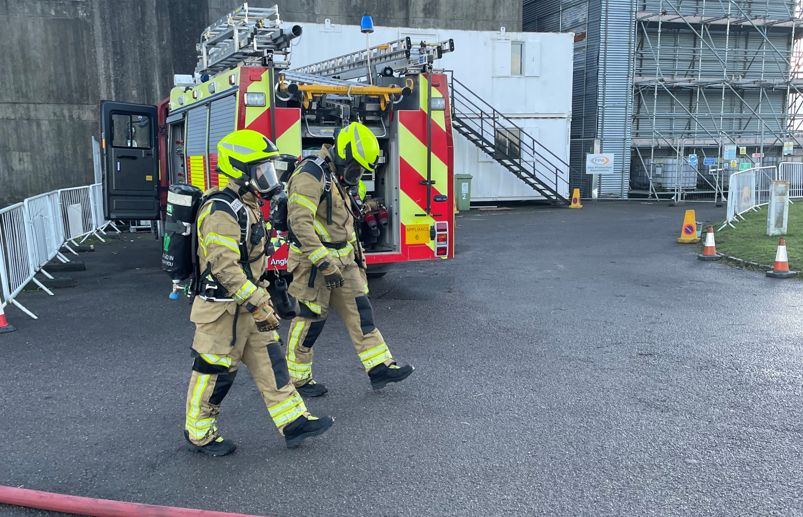
Protective gear for firefighters is not simply clothing; it is specialised life-safety equipment that has to balance protection with comfort, durability, and real-world usability for people whose bodies, careers, and needs change over time. The design process that creates this gear is long, iterative, and deeply rooted in listening to the people who wear it.
I visited Yate, the home of Bristol Uniforms Ltd, part of MSA Safety, to talk to Christian Hutter. Christian is head designer and focused on firefighter PPE but his journey into this world came after years in fashion, music, costume, and university teaching.
He tells me that the more time he spent working with firefighters and on their protective garments, he realised it was where he could see himself working for the rest of his career, “because it is something I believe in.” That sense of purpose sits underneath every pattern piece and every design decision.
He explains that the design process starts with blocks, not garments. In the world of protective clothing, a “block” is the fundamental pattern from which tunics and trousers are built. At MSA Bristol, these tunic and trouser blocks have been developed over decades. They are part of the “handwriting of the brand,” as Christian describes it.
“Everything that we do stands on the shoulders of those Bristol blocks,” he explains. “We continuously evolve them to fit the times we live in and what we believe is the next era of firefighting. The core blocks and how they perform across the size range is something that’s very precious to us.”
When Christian joined Bristol in 2015, there was already a history of women-specific PPE, unusual in an industry long built around male shapes. Today, the team has moved beyond the old split between male and female garments. The new approach is about fit for form rather than fit for gender.
A key part of the new X1 range has been to abandon labels like ‘medium’ or ‘3XL.’ “We’ve changed the sizing expressions now,” Christian says. “We’re not using those terminologies like medium or two extra large or three extra large. That’s changing.” Instead, the range is built around alpha-numeric codes, with 63 tunic sizes and 63 trouser sizes, each with built-in adjustability.
“The aim is to cover the full bell curve of real firefighters’ bodies, helping everyone find their best fit, and then be able to fine-tune it.”
The team got there by digging into years of data: sold sizes, made-to-measure orders, and recurring alterations. As a result, themes emerged. Some firefighters needed a smaller waist but more allowance over their hips; others had broad shoulders but slim waists, or long legs with relatively short spines. Traditional automatic pairings of tunic and trouser sizes did not easily accommodate these proportions. It was time to think differently, says Christian.
The voice of the customer
At every stage, the ‘voice of the customer’ shapes decisions. Christian talks about sessions where firefighters are invited to “tell us everything.” Sometimes the feedback is about comfort, sometimes about dignity and confidence, like the anxiety of returning from maternity leave and having to ask for different sizes. Sometimes it is about behaviour, like where firefighters prefer to store their gloves when not in use.
“Everything that we do should be easy to solve, you would think, except that the heat challenges, potential snag risk and ergonomic demands of firefighting add a whole other level of complexity,” he explains.
Christian shares examples like tunics that get stuck on hips and refuse to fall back over trousers, sleeves that ride up, hems that leave gaps, or braces that cut into shoulders. By talking to those who wear the kit, the team can find out how even the annoying minor irritations can be solved, it can all add up and affect wearer concentration and comfort.
Every promising idea has to run the gauntlet of heat, flame, snag, contamination risk tests and meet PPE certification requirements. “This is where the wearer trials come into play and we put the designs though the real-life applications to help confirm they are fit for purpose.”
The rise of the G clip
One result of the feedback has been the creation of the ‘G clip.’ This is part of a new adjustability system on the new Bristol X1 tunic and a good example of how constraints that arise from working in extreme environments can be tackled.
To help firefighters manage fluctuations in waist and hip size, side panels can be drawn in or released using specially designed G clips and Nomex webbing. Christian says he collaborated with MSA’s helmet design and materials teams to develop a new clip that could meet EN ISO 15384 requirements to withstand 260 degrees for five minutes. What began as a small usability idea turned into a full materials-science project, ending with custom tooling and injection moulding.
The team responds where they can make the biggest impact. That has led to redesigned collars with better ‘bite’ that keep closing power after repeated washing, new particle-blocking wristlets that interface cleanly with small gauntlet-style gloves, and larger lower pockets with internal hooks so gloves can be stowed securely away from the breathing zone. And finally, braces get a whole redesign and are now fully detachable and selected by the wearer according to their unique form.
Design as a continuum
Some issues still resist an elegant answer, and Christian is candid about that. He describes there being a lot of “unfinished business, things we haven’t solved… yet.” This is something he continues to puzzle over, drawing inspiration from other garment sectors but constrained by the far stricter requirements of firefighting PPE.
Designing firefighter PPE, then, is not about chasing trends. It is, in Christian’s words, “always about protecting firefighters and meeting or exceeding rigorous regulatory standards, while being forever curious and fixing the issues that we hear about. We want firefighters to focus on the important job to be done without discomfort and distraction.”
Spending time with Christian reveals that PPE design is complex, combining data, fabric, material science, the extreme environment of firefighting and human behaviour. To find out more visit MSA – The safety company.
To read similar articles, check out our Products channel.
