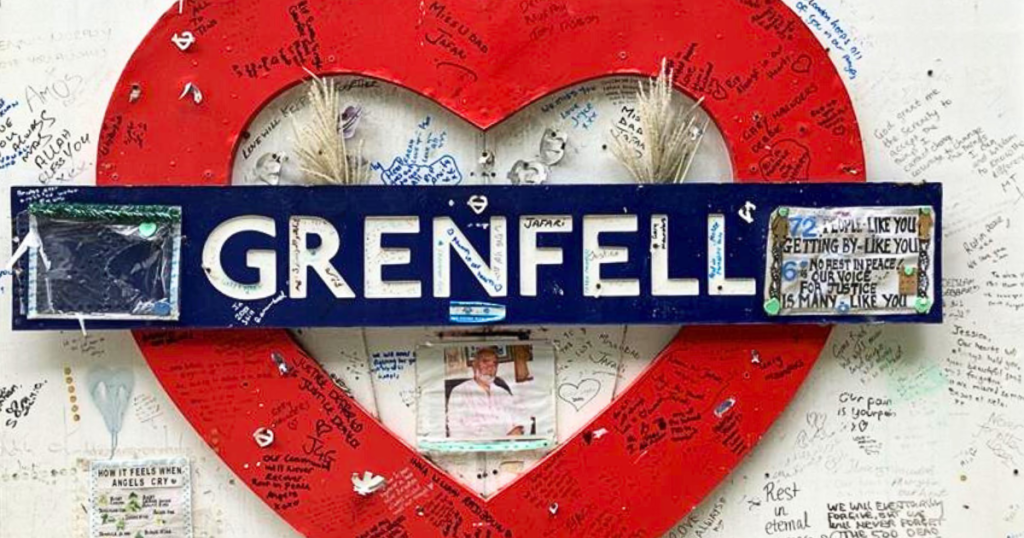
On the seventh anniversary of the Grenfell Tower fire, where we remember the 72 people who needlessly lost their lives, I continue to reflect on what I saw that night and have experienced as part of the grieving local community of North Kensington.
Anniversaries are hard: the mounting milestones without loved ones – birthdays, weddings, births; and the memories of ‘last times’ – that cup of tea, that passing comment. The shared anniversaries of disasters add another dimension and while we create accidental communities of grief, our biggest hope is for change. We owe it to those we have lost to alter how we listen and act on what we hear.
The landscape
The final Grenfell Inquiry Report will be published on 4 September 2024. It will land in a crowded landscape of reports and investigations, including the Stardust Inquest, the Infected Blood Inquiry, and the ongoing inquiries into Covid and the Post Office IT system. Together they provide the opportunity to tackle systemic cross-disaster issues, but they also challenge our ability to cause change.
Some of our critical emergency services, have deep and complex cultural issues. For example, the Home Affairs Committee recently said the work they had done ‘left us in no doubt that the fire and rescue service in England is institutionally misogynistic, racist and homophobic’. This work was being undertaken after several reports such as the Independent Culture Review of the London Fire Brigade, raised cultural issues.
More than 20 years after the Macpherson report into Stephen Lawrence’s death and following Sarah Everard’s abduction, rape and murder by a serving police officer, Baroness Casey found that there was ‘institutional racism, sexism and homophobia in the Met’.
Regarding the built environment, progress on culture change post-Grenfell remains slow. Judith Hackitt in her latest update, lamented the lack of industry-wide progress saying, ‘there remains significant room for improvement in building safety leadership.’
So, while the number of investigations into disasters happening concurrently provides the opportunity to tackle cross-disaster systemic issues, key organisations and industries have deeply embedded cultural issues that will inhibit change.
What is clear is that change is not guaranteed. From my perspective, two of the cross-disaster issues we need to lean into are risk blindness and risk inequity.
Risk blindness
My eyes have opened over the last seven years to what I call risk blindness, failure to respond to known hazards and risks.
Beyond Grenfell, we see this in the Infected Blood Scandal where the risks of contamination were known. I challenge anybody to read the Summary Report of the Infected Blood Inquiry without wanting to scream with rage. This blindness appears also to be present in the Post Office Scandal regarding the risks of the Horizon IT system.
Risk blindness is linked with cultural issues such as institutional defensiveness and a failure to act with candour.
Risk inequity
During expert evidence given at the Grenfell Tower Inquiry, we learned that 41 per cent of adults with an impairment (physical, mental, cognitive) died in the fire, compared with 18 per cent of adult residents with no impairments who were present in the building.
We see this risk inequity also with the Treloar’s children in the Infected Blood Scandal, where the most vulnerable were more exposed to risks, due to their conditions and as children with little agency. Only around 30 of the 122 pupils with haemophilia who attended the school between 1970 and 1987 survive. ‘The pupils were often regarded as objects for research, rather than first and foremost as children whose treatment should be firmly focused on their individual best interests alone.’
The impacts of climate change are further increasing risk inequity, making it perhaps, the existential issue of our time.
Communities of grief and change
We cannot underestimate the role of communities of grief in enabling change. Grenfell, Hillsborough, Stardust and the Post Office Scandal, to name a few.
Think of Ed Daffern, who repeatedly raised concerns prior to the Grenfell fire and was labelled ‘a rebel resident.’ Imagine a world where he was heard, and his words acted on. Where there would be no anniversary or coming together of this beautiful Grenfell community of grief.
Think of Brigette McDermott, now 87, who lost three of her children in the 1982 Stardust nightclub fire. Willie (22), Georgie (18) and Marcella (16). On the day of the jury verdict her daughter said, ‘Our mother is here, and we don’t know how she’s still with us, but she is and she was here today to get the unlawful killing (verdicts) of her three children. For 43 years we had to fight, and we shouldn’t have had to have done. None of us. We shouldn’t be here now; this should have been sorted and done long ago.’
The issue, so profoundly illustrated by these cases, is in our failure to listen and act on what these powerful agents for change say. Both before and after disasters. That is in our gift to change.
Read the latest update on the publication of the second Grenfell Tower Inquiry Report and the the ongoing work that may lead to criminal prosecutions.