


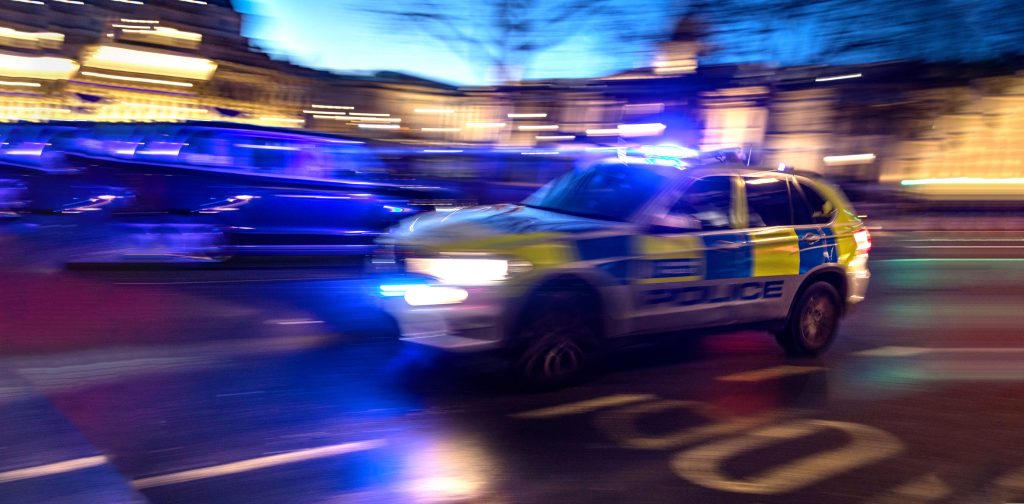
The National Police Chiefs’ Council has committed to the creation of a new national standard for the use of lights on police vehicles which is paving the way a consistent approach across all emergency service fleets.
Met Police fleet director, Jason Powell, is leading the work for the police chiefs and is working with transport engineering consultancy TRL to develop the standard in consultation with police fleet managers across England and Wales. Powell says the standard is necessary to bring consistency across all 43 forces as part of the government’s drive for police reform.
Currently, police vehicles – 19 different types including response cars, dog vans and specialist forensic vans – go through an extensive conversion process and part of that is fitting lighting to warn other road users of an emergency. Each force configures the lighting on the vehicle to its own design and as a result, the inconsistency can impact both public and officer safety.
Speaking to Ianto Guy, Principle Consultant at TRL, who is leading the project to create the standard, he explained why the standard is necessary and why TRL has been commissioned to do this work. He was the lead author on the National Fleet Standard and as a result of spending many years around policing, he has concluded that running a police fleet it like running a motorsport team. It’s a specialist fleet with specialist needs.
“For each light source, you’ve got the physical size of the light source, you’ve got how bright it is, you’ve got what colour it is, how much it flashes, what pattern it’s flashing with, and then you take those and you take a dozen of them, and you stick them all over a vehicle, and they all flash in a different way, and they’re all pointing in different directions.”
This complexity is one of the reasons that Powell is driving this change. By having a single national approach to how a police vehicle’s lighting is configured, it can bring together all the research, good practice and innovation so that all forces benefit without having to do through the same process 43 times. “There’s loads of loads of interesting insight out there,” adds Guy, “but there is no kind of single source of truth and there are many steps that you go through to ensure that the vehicle is visible in a way that is safe.”
The safety point is well made throughout this conversation with Powell and Guy. The safety of the officers who, wearing hi-vis jackets against a hi-vis vehicle where the lighting is blinding, become invisible as they blend in to the environment. Powell expands on how officer safety will be enhanced through this work.
“Officer safety will be improved by the fact that we have a nationally mandated standard that we can say the whole of the UK now operates this lighting standard. All the scenarios have been captured, and every officer, whether you’re in West Yorkshire, London, or Devon, you’ve got the same safety protection and the balance between detection and all of the other parts.”
Powell is keen to point out that the work taking place in policing is not new, he cites the national specification for a double crewed ambulance that means there is consistency across England. “We’ve got nationally mandated kit that police officers must carry and nationally mandated training, so why not do the same for the lighting on the vehicles?”
Keen not to stifle market innovation, Powell says that the standard will be output based, so any vehicle converter can win the work but will need to make sure that the lighting fits with the standard that will be owned nationally by the NPCC. For him, it’s a natural next step forward and in line with the ambitions for a national police service and the ongoing programme to standardise the base vehicle specifications and the conversion solution across the 19 categories of police vehicles.
It sounds like it might take a long time to come up with a standard but Powell says the work will be complete by October. Guy concludes: “We’re under no illusions about the scale of the job that we’ve got to do over the next few months.”
For more conversations about fleet, be sure to register to attend The Emergency Services Show where a new Fleet of the Future stage will provide a platform for sharing innovation across the sector. Register now to secure your spot on 16 And 17 September at the NEC in Birmingham.
