


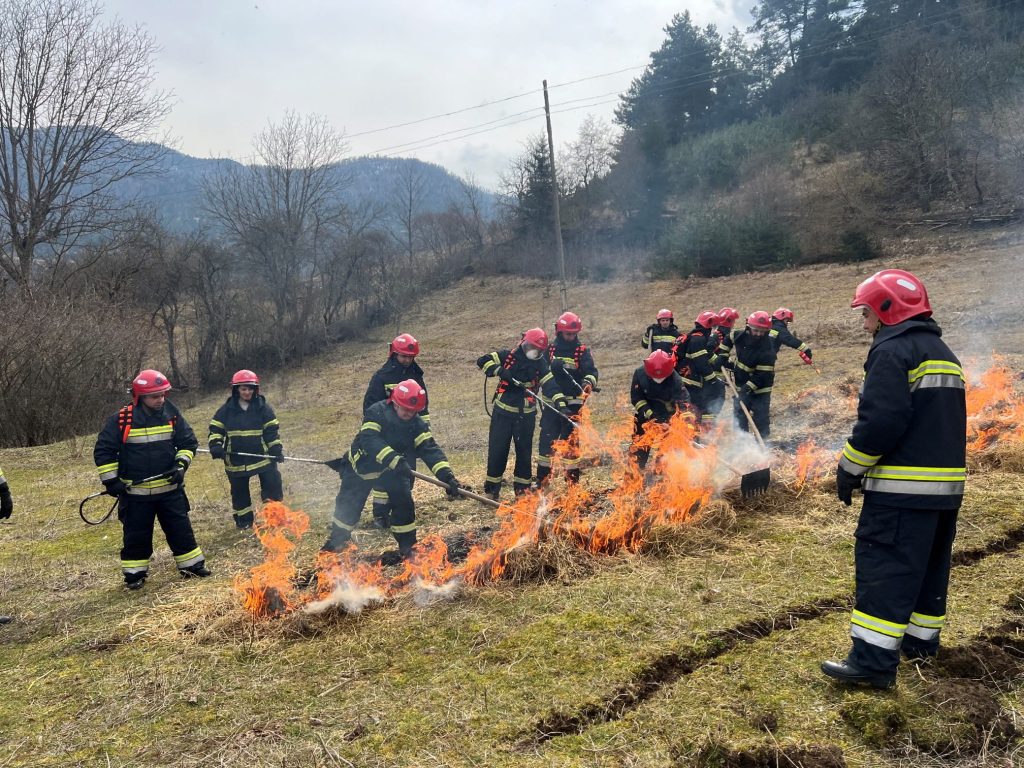
With the topic of resilience in the news more than ever as we see the continued impact of heat and wildfires, I talk to Ben Hall from the Resilience Advisors Network about how the combination of his extensive experience of working in the UK fire and rescue service along with work in countries around the world including three years in Georgia shapes how he sees the future of resilience and emergency response in the UK.
Through RAN – the Resilience Advisors Network – Ben spent three years supporting the development of Georgia’s emergency management system, a UN‑funded project designed to help the country move closer to European Union membership.
Ben says that Georgia already had capable and experienced firefighters, medical responders, officers and volunteers. The role of the RAN team was to work alongside Georgian colleagues, bringing together relevant European expertise to help review existing arrangements, identify priorities and strengthen particular areas. This included SOPs, training systems, command arrangements, train-the-trainer development and practical frontline training. “It was collaborative capacity-building rather than an externally imposed rebuild,” he adds.
“We looked at how to rebuild their technical capabilities, from their 112 emergency system to the response capability,” Ben explains. RAN assembled European specialists whose experience matched the priorities identified with Georgian counterparts. Over three years they developed trainers, rewrote procedures and delivered hands-on training: “That started from redesigning all their policies right down to actually training the firefighters in rescue on the ground.”
A distinctive feature in Georgia was the blend of national, professional services and emerging volunteer forces, particularly in rural and mountainous regions prone to wildfires, mudslides and other climate-related hazards. “They used volunteers as well as professional firefighters,” Ben says. “Part of the work we were doing was helping build the capacity within that.” Those volunteers often operated in small, remote communities. “The volunteer one gave us a real challenge because a lot of our training was in the city centre in the capital city of Tbilisi, and the challenges there were totally different from some of the rural areas of Georgia.”
Ben says that the challenges in the urban environment, like the capital city Tbilisi, are in stark contrast to the experience in more rural environments where responders are dealing with wildfires and mudslides. “Regardless of their setting, they want to support each other when these things happen,” he says.
The real challenge lies in aligning perspectives on what an emergency is and how to manage it.
“The firefighters were worried more about the response, whereas some of the volunteers in more remote regions were more worried about actually how do we get help? The would be saying ‘we’ve had a mudslide, how do we get EMS here in the first place to support us?’”
For Ben, this experience shines an uncomfortable light on the UK’s position. While the UK has a mature fire and rescue system, he believes it is at risk of working in isolation just as the pressures of climate change intensify. Brexit, he argues, has exacerbated that. “Brexit has been a problem in terms of where the UK is now going with its response. What’s becoming really clear to us is the silo that the UK is working in that many European countries aren’t at the moment.”
Wildfires are a case in point. “While the UK can still request international assistance, it is no longer embedded in European civil-protection arrangements in the same way.” Ben’s concern is that this risks weakening the routine relationships, shared learning and joint preparedness needed before a major incident occurs.
By contrast, in Georgia and across mainland Europe he sees a willingness to learn collectively, share technology and treat climate-driven emergencies as complex, cascading events rather than single incidents. “We need to look beyond a single climate-driven event causing one single problem,” he says, pointing to European examples where wildfires are understood as triggers for water shortages, mass evacuation and long-term displacement.
Ben’s work through RAN and the Crisis Management Innovation Network Europe reinforces his belief that the UK must look outward, not inward. He argues that accepting that others have more experience is not a weakness but a prerequisite for resilience.
The lesson from Georgia, for Ben, is that transformation is possible when a country is honest about its gaps, open to external expertise and prepared to rewire systems from policy to frontline practice. The question he poses implicitly for the UK is whether it is ready to do the same before the next crisis forces the issue.
Ben joins a panel at The Emergency Services Show which is looking at resilience and the development of National Occupational Standards for Resilience. Under pressure: Is your workforce ready? is at 1320 on 16 September. Register for your free ticket here.
