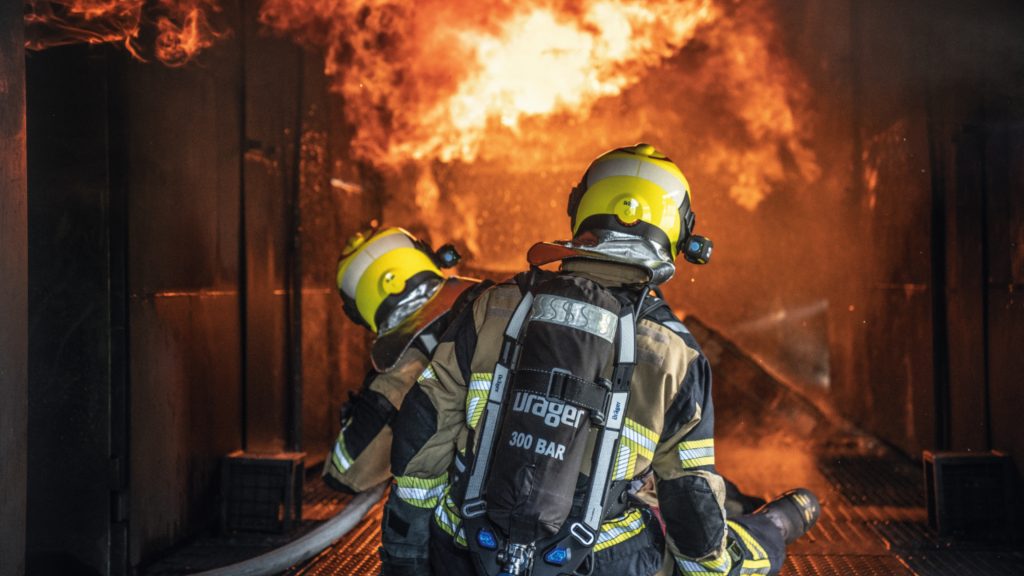
Firefighting is a dangerous profession – it exposes firefighters to high levels of smoke, extreme heat and hazardous environments for extended periods of time. However, progress in the technology associated with the design and use of self-contained breathing apparatus (SCBA) has been proved to make significant advancements in their safety.
Indeed, it could be said that a firefighter’s breathing apparatus is the only equipment that is purely designed for their protection. This dedicated focus on firefighter wellbeing and safety is why I’m always keen to promote the benefits of emerging technology incorporated into breathing apparatus and its use, to ensure that firefighters can benefit.
The turning point
The 1950s saw a significant turning point in the use of SCBA and firefighter health, following the tragic 1958 fire at Smithfield Market, which saw two firefighters lose their lives and many injured or treated for smoke inhalation. The two firefighters who lost their lives ran out of breathing air while navigating the complex, smoke filled site.
This prompted a policy change on the management of wearers of breathing apparatus to ensure greater accountability for firefighters entering an incident. The change also demanded a greater understanding of how long the individuals’ air supply would last. The ‘BA Board’ was therefore introduced, which involved the use of BA tallies and the keeping of meticulous records of the time spent inside an incident. The fundamentals of this system of accountability and the management of breathing apparatus are still in place today.
Designing for the firefighter
When firefighters enter hazardous environments, it is essential that equipment not only protects them, but is also comfortable and lightweight, increasing agility and reducing fatigue. The Dräger NANO, Type 4 full composite cylinder, for example, is utilising a combination of carbon fibre composites and graphene-based materials to minimise the weight that firefighters carry.
Additionally, the science of ergonomics has been applied in the design of Dräger’s PSS AirBoss breathing apparatus resulting in enhanced comfort and improved mobility, allowing wearers to navigate challenging environments more easily.
Supporting technology
Designing SCBA for the firefighter is not just about the equipment itself, indeed there is a plethora of supporting technology being put to work to increase situational awareness and firefighter safety. Today’s communication tools and accountability systems, for example, have been developed to allow crucial live data to be transmitted between the firefighters in operation, and the incident commander.

Dräger’s Fireground system enables each firefighter’s conditions to be individually monitored, even in large-scale and complex scenarios. This, in turn, reduces manual processes and improves firefighter safety, because the entry control officers and incident commanders can achieve excellent situational awareness by reviewing live data transmitted from the firefighting equipment, rather than manually collating information.
The system allows for the remote and simultaneous monitoring of multiple incidents producing a comprehensive incident log for organisational review once the incident has been closed. The data collected can then be used to help with post-incident debriefings and accident investigations.
Advanced thermal imaging technology is also playing a critical role in keeping firefighters safe and orientated within an incident, even in thick smoke – while also helping to locate victims. Dräger’s UCF FireCore thermal imaging camera can now provide the wearer with continuous vision at the scene, providing a hands-free thermal image that is always in the firefighter’s line of sight, enabling them to focus, act quickly, and resolve issues more efficiently and safely.
Future firefighter health
Manufacturers, fire services, trade unions and government bodies are united in the goal of ensuring that those risking their lives on the front line are given the best protection available. As an industry, we have the skills, experience and technology at our disposal and the future of firefighter health will continue to improve if we in the fire sector can work together in the most efficient ways possible.
Dräger is a Premier Partner at The Emergency Services Show at the NEC on 17-18 September, and will be exhibiting in Hall 5, Stand D180. Check out the full exhibitor list here.