


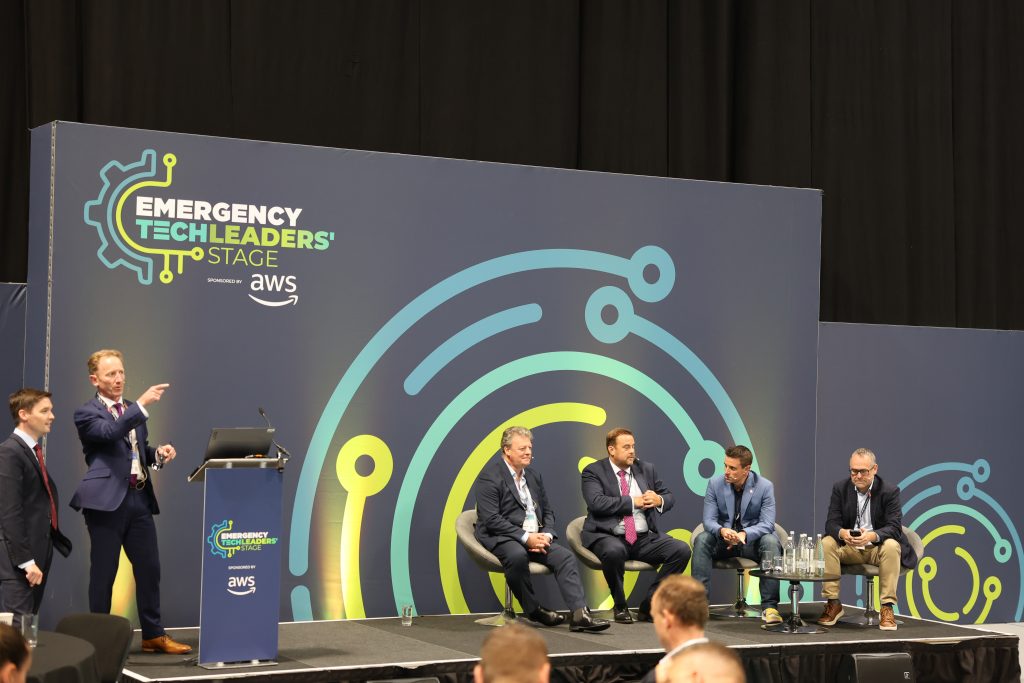
The Emergency Services Network (ESN) will redefine how the UK’s emergency services communicate and serve the public. At The Emergency Tech Show this year, the ESN team discussed the programme’s progress, the challenges ahead, and the opportunities it presents for frontline personnel.
Niall Stokoe, Director of Operations at ESN, described the project as “genuinely exciting.” Since signing contracts with BT/EE and IBM ten months ago, the programme has delivered five milestones, progressed infrastructure builds (particularly data centres) and continued coverage work through the Emergency Services Airwave System (EAS) programme. “Much of this work supports critical operational locations, ensuring the backbone we need for ESN is in place,” he said.
The programme’s leadership team brings decades of experience. Nigel Smith, Director for Delivery and Deployments, has 35 years in IT and large-scale programme delivery. Mark Nottage, Assistant Chief Constable and National Police ESN Coordinator, leads the NPCC, ESN and Airwave (NEAT) team, ensuring frontline operational requirements remain central. From the supplier side, Mark Taylor of IBM Consulting oversees user services delivery, while Matt Hall, BT/EE End-to-End Solutions Director, has been involved in mobile service delivery from 2G to 5G and has worked on ESN for over a decade.
At the heart of ESN is the need to provide frontline responders with a communications platform that does more than just replace Airwave. Mark Nottage explained: “If I had a pound for every time a police officer said, ‘All I want to do is be able to do what I do on my own private phone, on my work network,’ I think I’d be very rich.” ESN aims to provide a “big fat pipe” capable of handling voice, video, and data, enabling better situational awareness, joint risk assessment, and integrated applications. But he emphasised that above all, “the radio must work when we press it, all of the time.”
Once this basic reliability is ensured, ESN opens the door to further improvements. “It becomes a really amazing data platform,” said Mark Taylor, pointing to future applications such as AI, 5G-enabled services, and enhanced operational analytics.
The team are keen to enable further “transformational” innovation like apps and video data. Mark Nottage sees the opportunity to “seamlessly identify risk, push information, and improve operational efficiency,” while also safeguarding control room staff from constant exposure to trauma.
“Our mantra the whole time is to support the programme in getting off Airwave as quickly, safely, and affordably as possible.”
Collaboration, a key part of the programme, will be aided by co-located offices, shared governance, and transparency help the team address issues quickly, and the panel stressed the importance of sharing experience across the supply chain to deliver the service users need.
Device procurement, control room integration, and coverage validation are areas of focus when it comes to the technical challenges. Testing has been extensive, especially in high-attendance events. “We’ve been continually testing, validating the solution, to prove the network in high consumer footfall environments,” said BT/EE’s Matt. Critical operational locations are also a focus, ensuring resilience and reliability from day one.
Large-scale communications, such as those needed during mass incidents, have also been tested. Matt highlighted extensive modelling to ensure the network can handle high-capacity scenarios, while Mark Nottage stressed the importance of operational evidence: “We know we need it to work for 1,000 officers in one square mile, and we’re going to need it to work for one officer in 1,000 square miles.”
Looking ahead, frontline users are set to benefit in phases, as the contracts signed ten months ago have enabled integrated delivery planning. Radios will be the first target, followed by a full voice service and transition off Airwave planned for the early part of 2028, and coordination between forces will be crucial to ensure a smooth, safe transition.
The panel was a fascinating insight into innovation that is set to make a huge difference to frontline staff. With robust partnerships and rigorous testing, ESN is shaping a future where the UK’s emergency services can operate with unprecedented efficiency, resilience, and connectivity.
Listen to the full panel discussion below.
To read similar articles, check out our Technology channel.
